
54%
of UK adults now use AI tools, up from 31% a single year earlier.
Ofcom, 2025
Millions of people now take their questions, their goals and their hardest moments to AI chatbots that were never designed to hold them.
We built the AI in Loops differently. On purpose, with evidence, and with a line we never cross.
of UK adults now use AI tools, up from 31% a single year earlier.
Ofcom, 2025
UK adults have used AI for emotional support, companionship or social interaction in the past year.
AI Security Institute, 2025
of 25 to 34 year olds have used an AI chatbot to support their mental health or wellbeing.
Mental Health UK, 2025
of under-30s have told an AI something they've never told another person.
YouGov, 2025
And among young people across Europe, chatbots now outrank psychologists on how easy they are to open up to. 51% say it's easy to discuss mental health with a chatbot. Only 37% say the same of a psychologist. (Ipsos BVA for CNIL, 2026)
People aren't waiting for permission. They're already there.
Six in ten of those emotional conversations happen on general-purpose chatbots. Tools built to answer anything, for anyone, that were never designed to support someone who's struggling. Only 5% of people use anything purpose-built. (AI Security Institute, 2025)
The consequences are documented, not hypothetical.
of UK adults who used chatbots for mental wellbeing report receiving unsafe content about suicide.
Mental Health UK, 2025
of licensed psychologists surveyed say chatbots may reinforce harmful beliefs. 89% say they may inadvertently encourage self-harm.
APA, 2026
therapists working with children have witnessed a chatbot giving damaging advice.
BACP
Regulators have started drawing lines too. Illinois banned AI-only therapy in 2025, with other US states following, and UK charities are calling for formal safeguards.
None of this means AI is the problem. It means unboundaried AI is.
Where AI is purpose-built, clinically aware and knows its limits, it genuinely helps. AI tools embedded in NHS services have supported hundreds of thousands of people, widened access for communities that were being missed, and helped people improve while waiting for human care.
Nature Medicine, 2024; NHS Talking Therapies data
Where AI is a general chatbot optimised for engagement, with no boundaries and no handover, the harms show up.
The difference isn't AI or no AI. It's design. Whether the tool was built for the person in front of it, and whether it knows when to stop.
That's the standard we built Loops to.
The AI in Loops knows your goals, your loops and your progress. Ask it for loop ideas when you're stuck, or advice on getting past a hard moment, and the answer fits your life. You never start from zero, and you never have to explain yourself twice.
Walls of text overwhelm the ADHD brain, so Loops never sends them. Every response arrives as short, bite-sized cards you can take in one at a time. The AI is trained on ADHD itself: what it is, how symptoms show up, and how the ADHD brain prefers to receive information. Everything, from how it presents an answer to where it draws its limits, is optimised for your brain. Not the average brain.
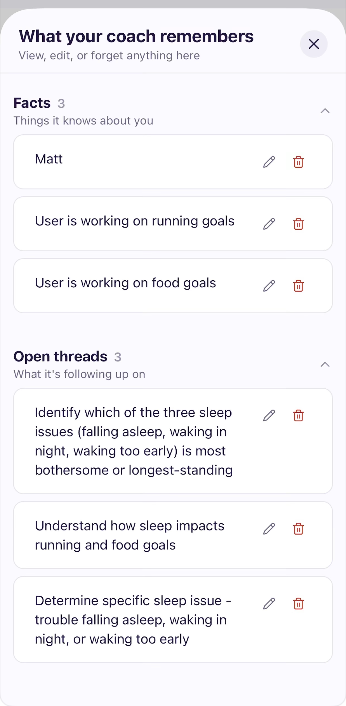
General chatbots build a picture of you in the background. You can't see it and you can't control it. In Loops, tap the brain icon in your AI chats and you'll see exactly what the AI is learning about you. That context is what makes your answers better over time. And it's yours. View it any time. Delete a little or delete it all. If something's wrong, or you'd simply rather it didn't know, you're one tap from removing it.
Not hidden context. Context you control.
Everything your coach has learned sits on one screen. The facts it holds about you, and the threads it is still following up on. Edit any of it, or delete it, whenever you like.
An AI can hold the world's knowledge. Research papers, expert advice, everything ever written about ADHD that it authorises. And there is still a moment when none of that is what a person needs. When the right answer isn't information. It's a trained human.
We've worked very hard to know exactly where that moment is. It's the most important thing we've built.
The AI in Loops will never tell you what condition you do or don't have. 64% of Britons worry about AI misdiagnosis, and they're right to. Diagnosis belongs with qualified professionals, and only them.
Coaching helps you act on your goals: what to do today, how to build momentum, how to recover when a week goes sideways. Therapy is something else entirely, and it belongs with trained, accredited humans. Loops knows the difference and stays firmly on the coaching side, every time, no matter how the question is phrased.
General chatbots are built to keep the conversation going. Loops is built to know when the conversation shouldn't be with an AI at all. If what you need has moved beyond coaching, it says so, plainly and kindly, and points you to the right human support.
If Loops recognises that you might be in distress or crisis, coaching stops. Completely. Its only job in that moment is to get you to real human support, clearly and quickly.
No lectures. No judgement. No attempt to keep you in the app. Just a calm, direct path to people trained for exactly this.
Call 116 123, free, any time of day or night.
Text SHOUT to 85258 for free, confidential support by text.
For urgent mental health support, call 111 and select the mental health option.
If you or someone else is in immediate danger, always call 999.
You could. A third of the United Kingdom already does. But now you know what the trade-offs are.
Context. Control. And a line we never cross. That's the whole difference, and it's everything.
Loops brings together small daily actions, a buddy, a journal and AI coaching designed with more care than the tools most people are using for far more serious things. Start with one small loop today.
New to Loops? It's a free ADHD app built around small daily steps, and almost everything in it costs nothing.
Loops is a coaching app, not a medical or therapeutic service. If you're worried about your mental health, please speak to your doctor or a qualified professional. You can also find crisis lines and specialist support on Find help now.
Statistics on this page are drawn from Ofcom, the UK AI Security Institute, Mental Health UK, YouGov, the American Psychological Association, BACP and research commissioned by CNIL, published 2024 to 2026.