
You sat down to work an hour ago. You've produced nothing. You're not sure where the time went.
Designed for ADHD. Works for everyone.
You can focus. You just can't make it happen when you need it.
ADHD attention doesn't disappear. It arrives and leaves on its own schedule. The problem isn't concentration. It's that concentration won't come when called.
Loops is a daily coaching app for people with ADHD. It gives you low-friction ways into the work each day, coaching for when the session stalls, and, if you want it, one person whose quiet attention makes the session more likely to happen.
Get Your Account, Free Forever Today.
*Terms and Conditions Apply.
*Terms and Conditions Apply.
Three things Loops does for you
Start the session
One specific, low-friction way in, for the days when starting feels impossible.
Build conditions that help
External structure rather than willpower. The kind that works even when motivation doesn't.
Make something real
A session where something existed at the end that didn't at the beginning.
Loops is a daily coaching app for people with ADHD.
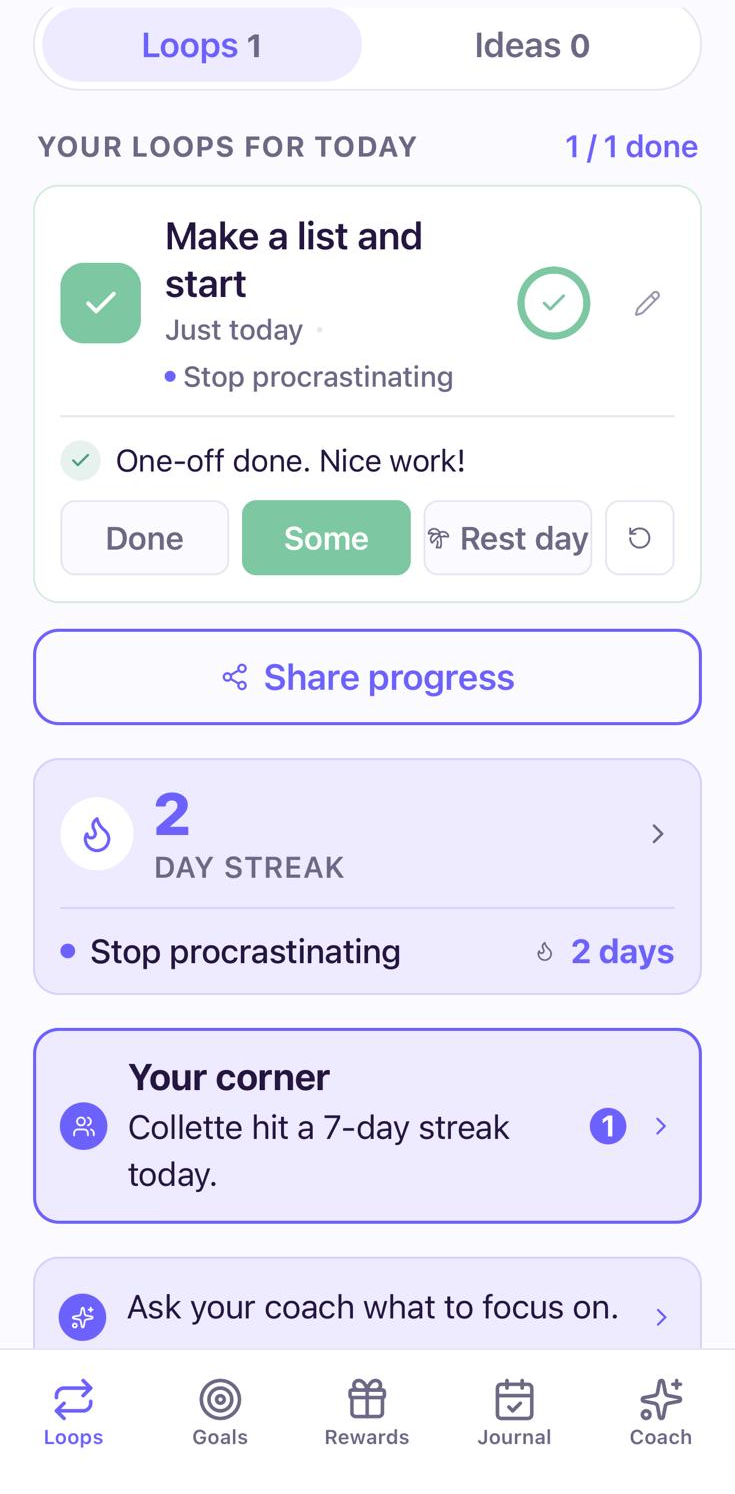
Today
Today's loops in one list. Mark it done, some, or a rest day, and see what your corner is up to.
How Loops helps
A daily system that builds the conditions for focus, rather than relying on it showing up.
Most focus advice assumes the problem is distraction. Remove the phone, close the tabs, find a quiet room. For ADHD brains, the problem is more specific: attention doesn't respond reliably to conditions. It responds to interest, urgency, and novelty. When none of those are present, the session doesn't happen regardless of how distraction-free the environment is.
Loops gives you specific session prompts each day, structures the entry point so that starting doesn't require a decision, and coaches you through the moments when the work usually stops. Not a focus hack. A daily structure that makes the session more likely to happen and more likely to produce something.
Then it adds the part most apps leave out. One person who sees you doing it. More on that just below.
Does any of this sound familiar?
You're not alone in this.
These are the patterns people with ADHD describe most often when it comes to focus and sustained attention.
When you're interested, you're completely absorbed. When you're not, you can't manufacture even ten minutes of useful concentration.
You opened a browser tab to look one thing up. Forty minutes later, you're not sure how you got here.
You started cleaning instead. You knew what you were doing. You did it anyway.
You have the skills. You have the knowledge. You have everything you need except the ability to sit with the work long enough to use any of it.
You've watched other people settle into sustained work and thought: genuinely, how do they do that?
This isn't a focus deficit. It's a focus regulation problem. And it responds to a very different kind of support than "try harder."
Understanding the pattern
It's not distraction. It's variability. And the difference matters.
ADHD attention doesn't work the way most focus advice assumes. Understanding the specific mechanisms changes what actually helps.
- 01
Moment-to-moment variability
ADHD attention doesn't stay flat. It spikes and crashes independent of effort or intention. Research documents high moment-to-moment variability in ADHD attention and arousal. This explains why the same task can feel manageable one hour and completely impossible the next, without anything external having changed.
- 02
Interest as the only reliable fuel
ADHD brains run on interest, novelty, and urgency. When none of those are present, focus doesn't activate regardless of how important the task is. This is the fundamental mismatch between ADHD attention and most work: importance doesn't motivate the way urgency does, and significance tomorrow doesn't compete with stimulation now.
- 03
Active avoidance
When a task feels too difficult to start, the brain switches to something easier. Not passively. Actively. The research names this specifically: cleaning, browsing, and reorganising are common ADHD avoidance responses to difficulty. The switch feels involuntary because it often is.
- 04
The competency ceiling
“If I can't do it immediately, what's the point?” isn't perfectionism. It's delay aversion. ADHD brains discount future rewards steeply, which means the effort of a hard session feels disproportionate to benefits that won't arrive for days or weeks. The result is a specific kind of stalling that looks like procrastination but has a different cause.
- 05
The session guilt loop
A lost session doesn't just waste time. It makes the next session harder to start. When a work session fails to produce output, the guilt and shame that follow add emotional weight to every subsequent attempt. The task gains a reputation as something that goes badly, making entry harder each time.
Loops is designed to interrupt these patterns before they compound into another empty afternoon.
The insight that changes what preparing for a session looks like
The most effective focus support isn't trying harder. It's building better conditions.
Most focus advice is about generating focus from the inside: remove distractions, sit down, try harder. For ADHD brains, this approach competes directly with internal motivation that is unreliable by design. When the motivation isn't there, trying harder to generate focus through willpower is precisely the most effortful and least effective intervention available.
What works better is externalising the conditions that produce focus: a prompt that shows up at the right moment, a structure that makes entry low-friction, a session size calibrated to what's actually possible today. The environment does the work that motivation can't. This isn't a workaround. It's how ADHD focus actually functions when it functions well.
The part most apps miss
Brains finish for people, not for apps.
There's a reason so many people with ADHD get more done in a café, on a call with the camera on, or sitting near someone else working. It's called body doubling, and it works because another person is external structure the brain can borrow when its own won't switch on.
So Loops builds that in. The one thing that reliably keeps ADHD brains going. Another person.
You choose one person you trust. Your partner, a friend, whoever it is. When you close a loop, they see it. When you get back to the work after a stalled day, they see that too, and it's no big deal. You decide exactly what they can see, and you can change it any time.
This is the step most people skip with other apps. It's also the one that makes Loops work.
A person is external structure
Focus responds to conditions, not willpower, and another person is one of the strongest conditions there is. When someone can see the session happen, the work stops being purely internal, which is exactly where ADHD attention struggles.
They don't supervise you
They don't have to nag you or check your output. They don't manage you, they don't even pay. Their side is light on purpose.
You're always in control
You choose who it is. You decide exactly what they can see, and you can change it any time.
It's body doubling, built in
The thing that makes body doubling work, someone else present while you work, without needing to book a call or share a room. One person whose quiet attention makes the session more likely.
You can start on your own if you'd rather. It still works. It just works better when someone can see you.
Getting started
One session. Made as easy as possible to enter. Today.
You don't need to wait until you feel ready. Loops is designed to make the session possible from exactly where you are.
- 1Step 1
Tell Loops what you're working on
Name the task or project. How much time you have. What a productive session looks like for today, not the ideal version. Plain language. No setup.
- 2Step 2
Choose your person
Pick one person you trust to see your progress, so the session has a bit of built-in body doubling. You decide what they can see, and you can change it any time. This is the step most people skip with other apps, and the one that makes Loops work.
- 3Step 3
Get specific session prompts
Each day, Loops gives you specific, low-friction ways into the work. Something concrete enough to start on immediately, sized to the day you're actually having rather than the day you planned. Close the loop, and your person sees it.
- 4Step 4
Get coached through the stall
Session grinding to a halt? Loops gives you a practical next action rather than a reminder of what you haven't done. Not motivation. Just the next smallest thing.
- 5Step 5
End the session with something real
Not a perfect output. Not everything done. Something that existed at the end that didn't at the beginning. That's enough.
You don't need focus to show up before you start. You need a structure that makes starting possible. That's what Loops is for.
What's inside Loops
Five simple things, working together.
01
One goal, in your own words
The task or project you're trying to focus on, described your way, and what a good enough session looks like today. Not the ideal version. Just a clear target, so each session has somewhere to point.
02
Loops that fit your life
A loop is one small, repeating action, at a pace you choose, built as a low-friction way into the work rather than a block of willpower. Some run every day, some a few times a week: open the file and write one line, fifteen minutes on the hard thing, one session before lunch. A few connect to the work. Others are just life, like taking your meds before breakfast. A stalled day is a data point, not a failure. The next small entry point is still there whenever you come back.
03
Your person
The one you choose to see your progress: the loops you close and the sessions that happened. Built-in body doubling, the thing that makes working near someone else work, without booking a call or sharing a room.
04
Rewards you can feel
Because the payoff of a session can feel days away, you promise yourself something for the moments that matter: a week of sessions that actually happened, the hard thing finally started, a run of focused days. Loops holds the promise and calls it in when you've earned it, and your person gets to see it too.
05
A coach who knows your whole story
An AI coach built for ADHD. It already knows what you're working on and where your sessions tend to stall, so there's no re-explaining yourself from the start. No booking, no waiting room. It's there when you've been staring at the screen for an hour, with a concrete way back in rather than a lecture.
What people say
From people who recognise themselves in this.
I spent two years thinking the problem was distraction. I removed every distraction I could find. The sessions still didn't happen. Loops helped me understand the problem was the entry point, not the environment. Now I have one.
Freelance writer
Diagnosed with ADHD at 28
I can hyperfocus for six hours on something I love. I couldn't get twenty minutes on something I needed. Loops didn't fix that gap. It gave me a structure for the need-to side that didn't depend on the love-to side.
Data analyst
Using Loops for 9 weeks
A session that actually produced something. That's all I wanted. Loops helped me make that happen more consistently than I ever have before.
Architect, Birmingham
Pricing
Choose your plan
One small subscription for the coach, the loops and the streaks. Or buy credits when you need them and nothing else.
- 100 coach messages every month. Free gets 30.
- Nothing rolls over, nothing is wasted. It just resets.
- Cancel anytime.
Loops Solo
Monthly$6.99/ month
1 week free, then $6.99 a month.
Your coach, your loops and your streaks. Month to month, cancel whenever.
Loops Solo
Annual$42.99/ year
Works out at $3.58 a month.
Your coach and your streaks, for a year. Roughly half the monthly price.
Or top up
One-off packs. These credits never expire.
100
credits
100 coach message credits
$3.99
300
credits
300 coach message credits
$9.99
1,000
credits
1,000 coach message credits
Best rate
$29.99
Every plan starts with a week free. On iPhone and Android.
A few things worth knowing
Common questions before you start
“I focus fine when I'm interested. The problem is boring tasks.”
That's exactly right. And it's exactly the problem Loops is built for. Interest-based focus is real and valuable. But the tasks that matter most often don't self-select for interest. Loops gives you the entry structure for the sessions where interest isn't enough to get you started.
“Do I have to share my progress with anyone?”
No. Solo works perfectly well on its own. But most people find it works better when one person can see them, partly because that quiet attention is body doubling built in. You decide what your person sees, and you can add them whenever you're ready.
“I just need to remove distractions. That's all.”
Distraction removal helps. It doesn't solve the entry problem. ADHD attention doesn't respond to a distraction-free environment the way other brains do. External structure that prompts and scaffolds the session works better than willpower-based distraction management.
“What if I'm not diagnosed?”
You don't need a diagnosis. Many people using Loops are on waiting lists, self-identifying, or simply recognise that the patterns here feel familiar. If that's you, Loops is built for you.
“What if I just can't focus today at all?”
That's what the session prompt is sized for. On days when focus isn't available, Loops gives you something small enough to be possible anyway. Even a very small session produces more than no session, and it keeps the work accessible for tomorrow.
FAQ
Questions people often ask
Still wondering if Loops fits how your brain works? Contact us. A real person will reply.
What is Loops?
Loops is a daily coaching app for people with ADHD and anyone building better habits. It combines personalised coaching, daily micro-actions, one person who sees your progress, and accountability in one system. For focus specifically, it provides the entry structure for work sessions that ADHD makes difficult to initiate and sustain.
Who is 'your person', and do I need one?
Your person is the one you choose to see your progress: the loops you close and the sessions that happened. It's body doubling built in, the reason so many people with ADHD focus better near someone else, without booking a call or sharing a room. They don't supervise you or nag you. You don't have to add one to start, but it's the part that makes Loops work, so we'll gently encourage it when you're ready.
How does Loops help with focus if you have ADHD?
It removes the decision of how to enter the work by giving you one specific, low-friction session prompt each day. It also coaches you through the moments when the session stalls, so a difficult start doesn't mean an empty afternoon.
Why does ADHD make focus so unpredictable?
ADHD involves high moment-to-moment variability in attention and arousal that isn't under voluntary control. Focus activates reliably in response to interest, novelty, and urgency, but not in response to importance or intention. This is why the same task can feel possible one day and completely unmanageable the next.
Do I need an ADHD diagnosis to use Loops?
No. Loops is designed first for people with ADHD but doesn't require a formal diagnosis. If the experiences described here feel familiar, Loops is built for you.
Is Loops a focus app like a Pomodoro timer?
No. Pomodoro timers structure time once you're already in the work. Loops addresses what happens before that: the entry point, the session prompt, and the coaching when things stall. It works well alongside a timer if that helps you once you're started.
What if a session produces very little?
A small output is still an output. Loops is designed to keep the work accessible rather than optimal, so a low-productivity session doesn't become a reason to avoid the next one.
Is Loops available in the UK?
Yes. Loops is available across the UK and is designed around UK contexts and guidance.
How long before focus sessions start going better?
Most people notice a shift within two to three weeks, less in how focused they feel and more in how often sessions actually happen. Improved session quality usually comes later, as the structure becomes more established.
A session that happened
A session where something gets done. That's enough to start.
Not sustained flow. Not a perfect afternoon. Just the work moving forward, in a session that happened rather than one that didn't, and, if you want, one person who makes that session a little more likely.
Get Your Account, Free Forever Today.
*Terms and Conditions Apply.
*Terms and Conditions Apply.
New to Loops? It's a free productivity app built around small daily steps, and almost everything in it costs nothing.
Our sources
Where this comes from
This page draws on ADHD clinical guidelines, research into attention variability, reward processing and time perception, and real accounts from people who can focus completely on some things and not at all on others. Here's where it comes from.
- 208 Evidence-Based Conclusions About the Disorder — PubMed
- Attention-Deficit/Hyperactivity Disorder (ADHD) in Adults — PMC
- Benefits and Harms of ADHD Interventions — PubMed
- Attention-Deficit/Hyperactivity Disorder (ADHD) in Adults — PMC
- Executive Functioning Heterogeneity in Pediatric ADHD — PMC
- Evaluating Dopamine Reward Pathway in ADHD — PMC
- Time Perception in Adult ADHD: Findings From a Decade, A Review — PMC
- Evidence of Emotion Dysregulation as a Core Symptom of Adult ADHD — PMC
- The Experience of Effort in ADHD: A Scoping Review — PMC
- How Do You Manage Task Initiation Paralysis When... — r/ADHD
- “My Only Productivity Comes From Panic.” — r/ADHD
- Hyperfocus in ADHD: A Misunderstood Cognitive Phenomenon — PMC
- How Do You Get ANY Work Done? What's Your Strategy? — r/ADHD
- Experiences of Criticism in Adults With ADHD: A Qualitative Study — PMC
- A Systematic Review of Interventions to Support Adults With ADHD at Work — PMC
- Sleep Problems in Adults With ADHD: Prevalences and... — PubMed
- Attention deficit hyperactivity disorder: diagnosis and management — NICE
- A Systematic Review and Component Network Meta-Analysis of ADHD Interventions — The Lancet Psychiatry
- Coaching for Adults With ADHD: A Prospective Study — PMC
- Evaluating the Evidence: A Systematic Review of Digital Interventions for ADHD — PMC
- Systematic Review and Meta-Analysis: Do White Noise or Pink Noise Improve Attention in ADHD? — PubMed
- ADHD Management Information, May 2025 — NHS Digital
- Living Well With Adult ADHD: Practical Strategies for Improving Your Daily Life — Knouse & Barkley, Routledge
- Motivation Deficit in ADHD Is Associated With Dysfunction of the Dopamine Reward Pathway — PMC
- Moderating Effect of Attention Deficit Hyperactivity Disorder... — PMC
- Self-Compassion in University Students With ADHD — Sage Journals
- If I Read “Try the Pomodoro Method” One More Time I'm Going... — r/ADHD
- Work-MAP Telehealth Metacognitive Work-Performance Intervention — PMC
- Adult ADHD Assessments and Diagnosis — PREPARE, University of York
- What Can Adults With ADHD Tell Us About Their Experiences? A Review of Qualitative Methods to Map a New Research Agenda — Unbound Medicine
- CBT for Adult ADHD: From Intention to Action — Psychwire
Loops is a daily coaching app, not a medical or clinical service. These sources inform how we think about ADHD and focus; they are not an endorsement of Loops by their authors.