
You pushed hard for months. Now you can't do the basics. You're not sure how you got here and you're not sure how to get back.
Designed for ADHD. Works for everyone.
This isn't laziness. This isn't weakness. This is ADHD burnout.
ADHD burnout isn't ordinary tiredness. It's a specific kind of collapse that happens when the brain has been running on extra effort for too long. And it doesn't respond to pushing through.
Loops is a daily coaching app for people with ADHD. It gives you small things to do, sized to the day you're actually having, and, if you want it, one person who's quietly there while you find your way back.
Get Your Account, Free Forever Today.
*Terms and Conditions Apply.
*Terms and Conditions Apply.
If you're struggling more than this page can help with, please talk to your doctor or a crisis line. You'll find options wherever you are on Find help now.
Three things Loops does for you
Start smaller than you think
One tiny action is more useful than waiting until you feel ready.
Reduce the load first
Recovery starts with less, not more.
Come back at your own pace
Not back to normal. Just back to something.
Loops is a daily coaching app for people with ADHD.
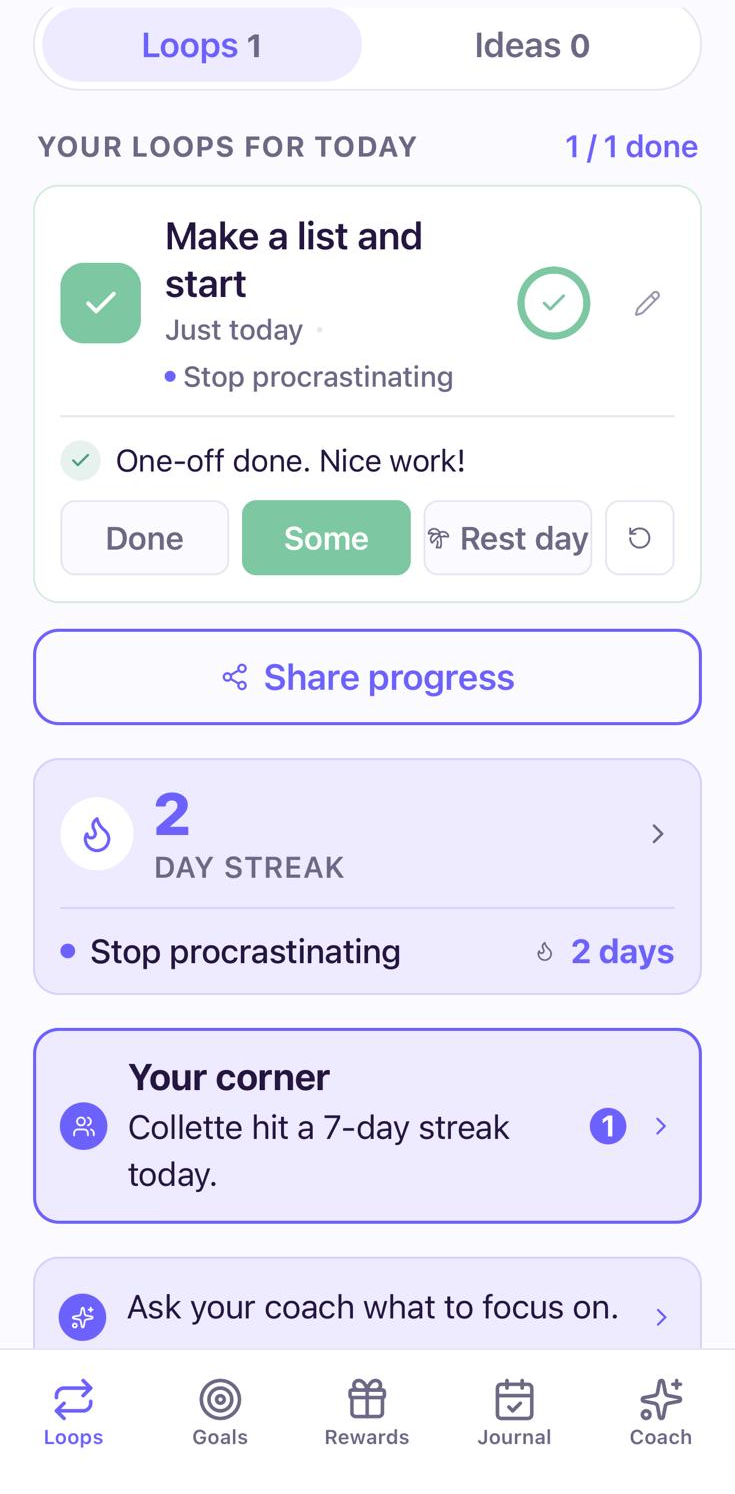
Today
Today's loops in one list. Mark it done, some, or a rest day, and see what your corner is up to.
How Loops helps
A daily system for people who aren't ready to be back to normal yet.
Most support for burnout assumes you're ready to do more. Loops assumes you're not. It's built for the in-between stage: when you want to start moving again but the thought of a full system, a full list, or a full day feels impossible.
Loops gives you small actions each day. Something you can actually do from where you are right now. No backlog to clear. No catching up. One thing, chosen to be as gentle as today needs it to be.
Then there's the part most apps leave out. One person, quietly alongside you. More on that just below.
Does any of this sound familiar?
You're not alone in this.
These are the patterns people with ADHD describe most often in and after burnout.
Things that used to feel manageable now feel impossible. Not hard. Impossible.
You've been here before. You recovered last time. But you're not sure you can do it again, and this time feels worse.
You know you need rest. But rest doesn't seem to be working. You're still exhausted after weeks of doing almost nothing.
The shame about what got left undone during the good stretch is almost as heavy as the burnout itself.
You're worried that the motivation that carried you through the last good period isn't coming back this time.
ADHD burnout is a real, recognised pattern. It has specific causes, and it responds to a different kind of support than ordinary exhaustion does.
Understanding the pattern
ADHD burnout isn't a failure of willpower. It's what happens after too much of it.
ADHD burnout follows a specific cycle. Understanding the pattern matters because it changes what recovery looks like and why standard advice so often makes things worse.
- 01
The hyperfocus-crash cycle
The good stretch costs more than it looks like it costs. ADHD hyperfocus can produce intense, high-output periods, but often at the expense of sleep, meals, and recovery time. When the focus breaks, the deferred cost arrives all at once.
- 02
The executive overdraft
Every day of extra effort leaves a deficit that doesn't fully repay overnight. ADHD brains spend more cognitive resource on routine tasks than other brains do. Over months, that cumulative gap becomes a debt the system eventually refuses to carry.
- 03
The open loops problem
Unfinished tasks don't just sit on a list. They sit in the mind, draining energy continuously. Research links executive dysfunction to fatigue: carrying dozens of pending decisions and unresolved tasks keeps the nervous system in a low-level state of alert, even during rest.
- 04
The fear that motivation won't return
One of the most painful parts of ADHD burnout is not knowing whether the motivated version of yourself still exists. ADHD affects the brain's ability to emotionally recall the feeling of being capable, which means that from inside a crash, the good period can feel irretrievably far away.
- 05
The pushing-through trap
The instinct to push through burnout doesn't speed recovery. It deepens it. Unlike some kinds of exhaustion, ADHD burnout worsens with additional executive demands. Rest that includes pressure to perform or resume normal output is not rest.
Recovery from ADHD burnout starts with reducing demands, not adding them. That's what Loops is designed for.
Something important to know about ADHD recovery
Lying still and waiting to feel better often doesn't work. Active rest does.
For many people with ADHD, passive rest, just stopping, creates its own problem: the open loops get louder, the shame gets heavier, and the gap between now and "ready to start again" feels wider each day.
What works better is something researchers and ADHD specialists call active rest: small, low-pressure engagement with things that feel genuinely enlivening rather than obligating. A short walk. Something creative. A task so small it barely counts. Not productivity. Not recovery. Just enough engagement to remind the brain that starting is still possible.
The part most apps miss
Brains come back for people, not for apps.
Burnout makes you disappear. You go quiet, you cancel things, you let the messages sit, and the longer it goes on the harder it is to reach back out. It gets very lonely in there.
So Loops offers you, gently, the one thing that helps ADHD brains most. Another person.
You choose one person you trust. Your partner, a friend, whoever feels safe. When you do the one small thing, they see it. Not to check up on you. Just so you're not completely on your own in it. You decide exactly what they can see, and you can change it any time.
This part is always optional, and there's no pressure to use it. But being seen, even a little, can make coming back feel less impossible.
They just have to see it
When you do the one small thing, they see it. Not to check up on you. Just so you're not completely on your own in it.
They don't expect anything
They don't nag, they don't manage you, they don't even pay. They're just there, quietly glad, on the days that feel like too much.
You're always in control
You choose who it is. You decide exactly what they can see, and you can change it any time. Always optional, no pressure.
Someone holds the belief
When you can't feel that the capable version of you still exists, sometimes someone else holding that belief for a while is enough.
"You don't have to do this alone."
And if you'd rather keep everything to yourself, that's completely okay. Solo works on its own. Your person is there for if and when you want it, and only then.
Getting started
One thing. Smaller than you think. Today.
You don't need to be ready. You don't need to feel better first. Loops is designed for exactly where you are.
- 1Step 1
Tell Loops where you are
Name what's hardest right now: getting out of bed, facing the backlog, managing basic things. No categories, no setup. Just where you actually are.
- 2Step 2
Choose your person, if you want one
This one is completely optional, and it's fine to skip it for now and come back later. If you'd like someone alongside you, pick one person you trust to see the small things you manage. You decide exactly what they can see, and you can change it any time. There's nothing for them to manage, and nothing for you to keep up.
- 3Step 3
Get the smallest possible actions
Each day, Loops gives you things to do. In burnout, that might be very small. Answering one message. Moving one thing. Eating something. The size is calibrated to what's actually possible today. Do it, and if you've chosen someone, your person sees it.
- 4Step 4
Get support when the shame hits
Burnout brings shame. Loops gives you a calm, practical response when the weight of it makes starting feel impossible again. Not motivation. Just the next smallest thing.
- 5Step 5
Move toward something, one day at a time
Recovery isn't linear. Loops isn't built around streaks or targets. It's built around the day you're actually having, and giving you something to do in it.
There is no wrong pace. One thing today is enough.
What's inside Loops
A few simple things, working together, as gently as you need.
01
One goal, held lightly
You don't need a big goal right now. Just name what's hardest: getting out of bed, the backlog, the basics. Loops holds it lightly, so there's something to come back to, at the pace you actually have. Not back to normal. Just back to something.
02
Loops that fit the day you're having
A loop is one small, repeating action, sized to the day you're actually having. On the hardest days it's tiny: answer one message, move one thing, eat something. On easier days, a little more. A few connect to what you're working back towards. Others are just life, like taking your meds before breakfast. There's no streak to keep and nothing to catch up on. If today wasn't possible, the next small thing is still there, whenever you're ready.
03
Your person, if you want one
Someone you choose to see the small things you manage, without expecting more. It's not there to check up on you, and it's completely optional.
04
Rewards, as kindness not targets
Promise yourself something gentle, for when you want it. Not a milestone to hit. Just a small, kind thing waiting for you: the good coffee, an evening with no obligations, a book you've wanted to sink into. Loops holds it, with no pressure and no deadline.
05
A coach who knows your whole story
An AI coach built for ADHD. It already knows where you are and what you're carrying, so there's no re-explaining yourself from the start. No booking, no waiting room. When the shame hits and starting feels impossible again, it's there with a calm response and the next smallest thing. Not a pep talk, not a plan.
What people say
From people who recognise themselves in this.
I couldn't understand why resting wasn't making me feel better. I'd been burned out for months and I was still exhausted. Loops gave me something so small I almost laughed. But I did it. And then the next day I did it again.
Nurse
Diagnosed with ADHD at 41
The shame about what I'd let fall apart was almost worse than the burnout. Loops didn't ask me to fix any of it. It just asked me to do one thing. That was different from everything else I'd tried.
Freelance designer
Using Loops for 11 weeks
I kept waiting to feel ready. Loops helped me understand I didn't have to feel ready. I just had to do something small enough to be possible.
Project manager, Cardiff
Pricing
Choose your plan
One small subscription for the coach, the loops and the streaks. Or buy credits when you need them and nothing else.
- 100 coach messages every month. Free gets 30.
- Nothing rolls over, nothing is wasted. It just resets.
- Cancel anytime.
Loops Solo
Monthly$6.99/ month
1 week free, then $6.99 a month.
Your coach, your loops and your streaks. Month to month, cancel whenever.
Loops Solo
Annual$42.99/ year
Works out at $3.58 a month.
Your coach and your streaks, for a year. Roughly half the monthly price.
Or top up
One-off packs. These credits never expire.
100
credits
100 coach message credits
$3.99
300
credits
300 coach message credits
$9.99
1,000
credits
1,000 coach message credits
Best rate
$29.99
Every plan starts with a week free. On iPhone and Android.
A few things worth knowing
Common questions before you start
“I just need to push through and get back on track.”
Pushing through is what caused the burnout. It's unlikely to end it. Research on ADHD burnout is consistent that additional executive demands during a crash deepen the depletion rather than resolving it. The path back is smaller, not harder.
“Do I have to share this with anyone?”
No. Solo works perfectly well on its own, and this can stay completely private. If and when you'd like someone alongside you, they add nothing for you to keep up, they just see the small things you manage. You decide what your person sees, and you can add them whenever you're ready, or not at all.
“I've tried to restart before and it never works.”
The restarts that didn't work were probably trying to do too much too soon. Loops is designed around the kind of start that's possible from inside burnout: one action, sized to today, with no expectation of the day after until it arrives.
“What if I'm not diagnosed?”
You don't need a diagnosis. Many people using Loops are on waiting lists, self-identifying, or simply recognise that the patterns here feel familiar. If that's you, Loops is built for you.
“What if this is more serious than burnout?”
It might be, and it's important to take that seriously. If you're experiencing persistent low mood, hopelessness, or thoughts of harming yourself, please speak with your doctor as soon as possible. Loops is not a substitute for professional support, and no amount of small actions replaces that conversation if you need it.
FAQ
Questions people often ask
Still wondering if Loops fits how your brain works? Contact us. A real person will reply.
What is Loops?
Loops is a daily coaching app for people with ADHD and anyone building better habits. It combines personalised coaching, daily micro-actions, one person who sees the small things you manage, and gentle support in one system. For burnout specifically, it helps with the gentlest possible re-engagement: one small action each day, calibrated to where you actually are.
Who is 'your person', and do I need one?
Your person is someone you choose to see the small things you manage, without expecting more. It's not there to check up on you, and it's completely optional. There's nothing for them to manage and nothing for you to keep up. You can skip it for now and add someone whenever you're ready, or not at all.
How does Loops help with ADHD burnout recovery?
It removes the pressure of deciding what to do and how much to do. Each day you get one action, sized to be genuinely possible today. There's no expectation of a full return to normal. Just one thing, for as long as that's what you need.
What is ADHD burnout and how is it different from ordinary exhaustion?
ADHD burnout comes from sustained over-expenditure of executive resources on a brain that finds routine functioning more demanding than other brains do. Unlike ordinary tiredness, it doesn't resolve with sleep alone. Recovery usually involves reducing ongoing demands and gently re-engaging with low-pressure activities rather than resting completely.
Should I see a doctor about my burnout?
Yes, if it's significantly affecting your daily life. Burnout can look like depression, and sometimes it overlaps with it. Your doctor can help you work out what's happening and what kind of support is appropriate. Loops works well alongside professional support but is not a replacement for it. You can find crisis lines and support by country on Find help now.
Do I need an ADHD diagnosis to use Loops?
No. Loops is designed first for people with ADHD but doesn't require a formal diagnosis. If the experiences described here feel familiar, Loops is built for you.
What if I'm in crisis right now?
Please reach out to someone who can help. You can contact your doctor or a crisis line, and you'll find crisis lines and support wherever you are on Find help now. Loops is not the right support for a mental health crisis, and we don't want you to be alone with that.
How long does ADHD burnout recovery take?
There's no fixed answer, and it varies significantly between people and situations. Recovery is usually not linear. Loops is designed to be useful throughout: in the early days when even tiny actions feel hard, and later when re-engagement starts to feel more possible.
Is Loops available in the UK?
Yes. Loops is available across the UK and is designed around UK contexts and guidance.
One small thing
One small thing today. That's all.
Not back to normal. Not recovered. Just one thing, from where you are, at the pace you actually have, and, if you want, one person quietly there while you do.
Get Your Account, Free Forever Today.
*Terms and Conditions Apply.
*Terms and Conditions Apply.
New to Loops? It's a free ADHD app built around small daily steps, and almost everything in it costs nothing.
If you need more support than this right now, please speak to your doctor or find a crisis line on Find help now.
Our sources
Where this comes from
This page draws on ADHD clinical guidelines, research into executive function, emotion regulation, sleep and burnout, and real accounts from people who have lived through the hyperfocus-crash cycle. Here's where it comes from.
- Attention deficit hyperactivity disorder: diagnosis and management — NICE
- Delay Aversion and Executive Functioning in Adults With ADHD — PMC
- A Systematic Review and Component Network Meta-Analysis of ADHD Interventions — The Lancet Psychiatry
- A Systematic Review of Interventions to Support Adults With ADHD at Work — Frontiers
- Executive Function Deficits Mediate the Relationship Between ADHD and Job Burnout — AIMS Public Health
- The Experience of Effort in ADHD: A Scoping Review — Frontiers
- Evidence of Emotion Dysregulation as a Core Symptom of Adult ADHD: A Systematic Review — PLOS One
- Executive Function Skills — CHADD
- Experiences of Criticism in Adults With ADHD: A Qualitative Study — PLOS One
- Stress and Work-Related Mental Illness Among Working Adults With ADHD — Springer
- Sleep in Adults With ADHD: Systematic Review and Meta-Analysis — ScienceDirect
- How Do You Get Any Work Done? What's Your Strategy? — r/ADHD
- A Meta-Analysis of Randomised Controlled Trials on Adult ADHD Treatment — PubMed
- Coaching for Adults With ADHD: A Prospective Study — Sage Journals
- The Experiences of Adults With ADHD in Interpersonal Relationships and Support Networks — ScienceDirect
- Plain English Summary of the ADHD Taskforce Report — NHS England
- The Lived Experiences of Adults With Attention-Deficit/Hyperactivity Disorder — Frontiers
Loops is a daily coaching app, not a medical or clinical service. These sources inform how we think about ADHD and burnout; they are not an endorsement of Loops by their authors.