
You've bought courses you never finished. Some you never started. You were genuinely excited about all of them.
Designed for ADHD. Works for everyone.
You start things with real enthusiasm. You keep losing them anyway.
It's not a motivation problem. For many people with ADHD, the enthusiasm is genuine. The structure around it just doesn't survive the part where the novelty wears off.
Loops is a daily coaching app for people with ADHD. It gives you small things to do with the material each day, coaching for when the interest dips, and, if you want it, one person still paying attention when the novelty's gone.
Get Your Account, Free Forever Today.
*Terms and Conditions Apply.
*Terms and Conditions Apply.
Three things Loops does for you
Get past the beginning
The part where interest usually fades is the part Loops is built for.
Let the learning stick
Daily contact with the material, in a form the brain can actually sustain.
Still going, six months from now
Not mastery. Just: the thing you started, still there.
Loops is a daily coaching app for people with ADHD.
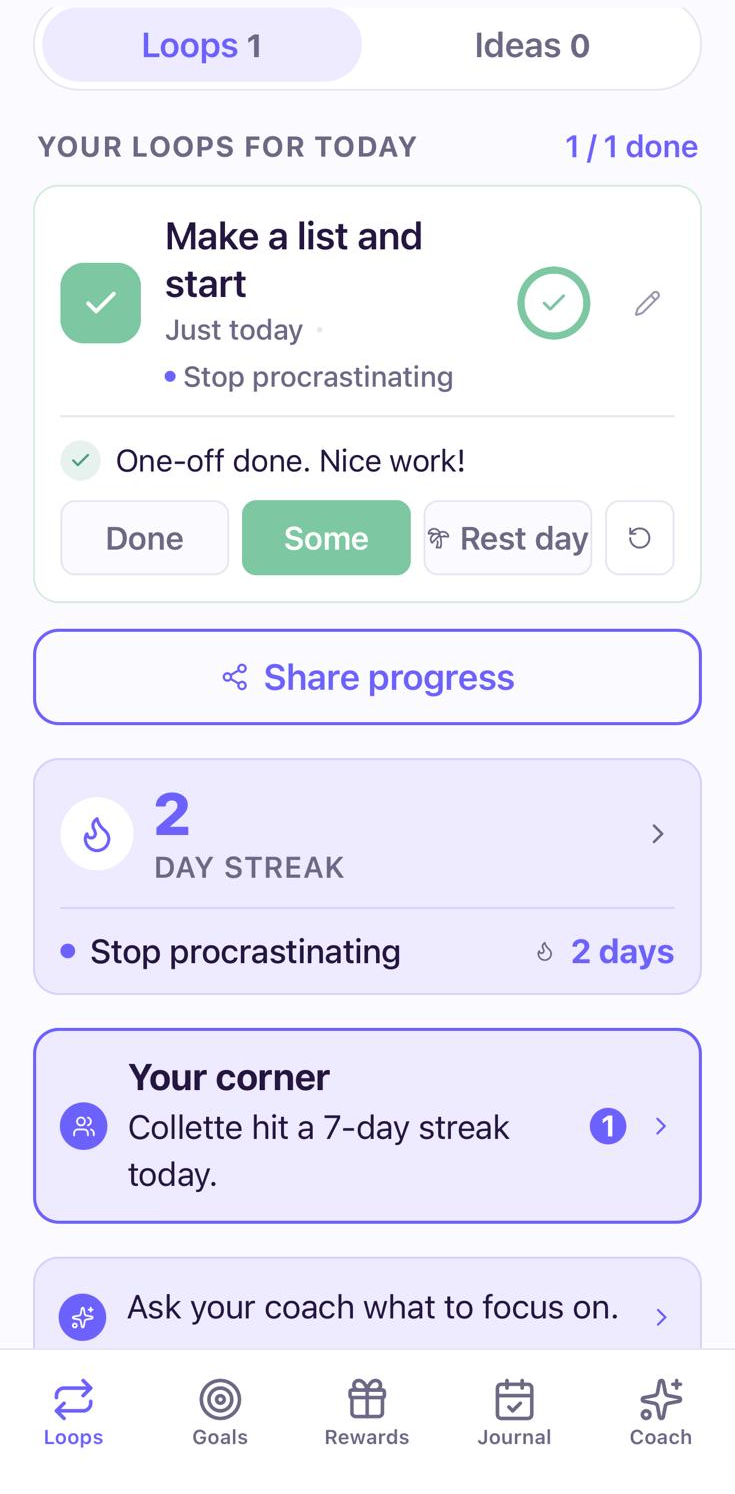
Today
Today's loops in one list. Mark it done, some, or a rest day, and see what your corner is up to.
How Loops helps
A daily system for the part of learning that enthusiasm can't carry.
Most learning tools are excellent at the beginning. They're designed for the part that already works for ADHD brains: the novel, the stimulating, the new. What they're not designed for is the middle, where the material gets repetitive and the dopamine that made starting easy has moved on.
Loops gives you specific learning actions each day, keeps the subject alive when interest naturally dips, and coaches you through the moments when the course usually gets quietly abandoned. Not a curriculum. A structure that survives.
Then it adds the part most apps leave out. One person who sees you doing it. More on that just below.
Does any of this sound familiar?
You're not alone in this.
These are the patterns people with ADHD describe most often when it comes to learning something new.
You learned the first 30% quickly and well. The next 70% never happened.
You've gone back to the same chapter or the same lesson several times because you can't retain what you covered before.
Something clicked and you understood it completely. Two weeks later, it was gone.
You've started to feel embarrassed about starting new things because you already know how it ends.
You're genuinely curious and genuinely capable. You just can't seem to get from interested to actually knowing it.
The enthusiasm was real. The problem isn't you. It's that learning something valuable requires sustaining engagement through a part that ADHD brains find genuinely difficult.
Understanding the pattern
It's not about finding the right subject. It's about what happens after the excitement does.
Learning with ADHD breaks down through a specific set of mechanisms. The beginning is rarely the problem. The middle is where things fall apart.
- 01
The novelty fade
The enthusiasm that made starting easy is neurological, not motivational. It doesn't last. ADHD brains are wired for immediate reward and stimulation. New learning produces a genuine dopamine response. That response fades as material becomes familiar, and the brain starts looking for something more interesting.
- 02
The working memory loop
It's not just forgetting. It's going back to the same chapters because nothing is sticking. ADHD impairs working memory, which means information learned in one session doesn't reliably consolidate. Without a system that revisits material in the right way, the learning has to start over each time.
- 03
The overwhelm collapse
A course that seemed manageable at sign-up feels impossible two weeks in. Once the initial structure of a course or programme runs out, or the material gets denser, the executive function demands of organising what to learn next often exceed what's available for actually learning it.
- 04
The shame-after-dropout spiral
Each abandoned course makes the next one feel more dangerous to start. ADHD's emotional dysregulation means that giving up on a course doesn't just feel disappointing. It accumulates. Eventually the anticipation of failure becomes a reason to avoid starting at all.
- 05
The system-not-the-subject problem
Finding a better topic doesn't fix the problem. It restarts the cycle. Many ADHD learners move between subjects looking for one that holds attention permanently. The research suggests the issue isn't the subject. It's the structure around the learning that needs to change.
Loops is designed to address all five of these failure points, not just the first one.
Something worth knowing about how ADHD brains actually learn
ADHD brains don't learn worse. They learn differently. And that changes what structure should look like.
Standard learning advice assumes motivation is something you maintain through discipline. For ADHD brains, motivation is something the brain generates when the material connects to genuine interest or immediate application. Discipline doesn't substitute for that connection. It just makes the absence of it feel like a personal failing.
This means the intervention isn't trying harder to concentrate. It's designing the learning so that interest keeps touching the material: small actions that feel connected to something real, visible progress that makes the effort feel worthwhile, and a structure that doesn't abandon you when the first wave of enthusiasm passes.
The part most apps miss
Brains finish for people, not for apps.
Learning something on your own is quiet work. Nobody knows whether you opened the course today, and when the novelty fades, there's nobody to notice you've quietly stopped. So it's easy to.
So Loops adds the one thing that reliably keeps ADHD brains going. Another person.
You choose one person you trust. Your partner, a friend, someone learning alongside you, whoever it is. When you close a loop, they see it. When you come back after the interest dipped, they see that too, and it's no big deal. You decide exactly what they can see, and you can change it any time.
This is the step most people skip with other apps. It's also the one that makes Loops work.
All they have to do is see it
When you close a loop, they see it. When you come back after the interest dipped, they see that too, and it's no big deal. They just get to watch you keep turning up to the thing you're learning, and cheer you on.
They don't test you
They don't have to nag you or quiz you. They don't manage you, they don't even pay. Their side is light on purpose.
You're always in control
You choose who it is. You decide exactly what they can see, and you can change it any time.
Still paying attention
When the enthusiasm that started it has moved on, one person still paying attention is often what keeps you going.
You can start on your own if you'd rather. It still works. It just works better when someone can see you.
Getting started
One learning action. Every day. Through the difficult middle.
You don't need a new course. You need something that keeps the one you already care about alive past the point where enthusiasm stops doing the work.
- 1Step 1
Tell Loops what you're learning
Name the subject, the skill, the course. Plain language. No categories or setup. Whatever you're trying to learn, however far in you already are.
- 2Step 2
Choose your person
Pick one person you trust to see your progress. You decide what they can see, and you can change it any time. This is the step most people skip with other apps, and the one that makes Loops work.
- 3Step 3
Get small daily actions
Each day, Loops gives you specific, low-friction things to do with the material. Small enough to be possible on a tired day. Targeted enough to move the learning forward rather than just revisit what's already comfortable. Close the loop, and your person sees it.
- 4Step 4
Get coached through the fade
Feeling like the interest has gone? Loops gives you something to do that keeps contact with the material, so the gap between sessions doesn't grow until returning feels impossible.
- 5Step 5
Build knowledge that actually stays
Consistent small contact with material, over enough time, is how learning sticks. Loops is designed to make that consistency achievable rather than aspirational.
You don't need to feel enthusiastic to do today's action. That's the point.
What's inside Loops
Five simple things, working together.
01
One goal, in your own words
The subject, skill or course you want to learn, described your way, and how far in you already are. With or without a finish line, whatever fits. Just a clear picture of what you're working towards, so it stays real when the novelty fades.
02
Loops that fit your life
A loop is one small, repeating action, at a pace you choose, small enough for a tired day and targeted so it moves the learning forward rather than just revisiting what's comfortable. Some run every day, some a few times a week: one lesson, ten minutes of practice, review yesterday's notes. A few connect to what you're learning. Others are just life, like taking your meds before breakfast. A missed one doesn't wipe you out. You can repair a streak simply by showing up again.
03
Your person
The one you choose to see your progress: the loops you close and the days you kept turning up to the material. Support, without the nagging or the testing.
04
Rewards you can feel
Promise yourself something for the moments that matter: a month of daily contact, the difficult middle you pushed through, six months in and still going. Loops holds the promise and calls it in when you've earned it, and your person gets to see it too.
05
A coach who knows your whole story
An AI coach built for ADHD. It already knows what you're learning and where interest tends to dip, so there's no re-explaining yourself from the start. No booking, no waiting room. It's there when the novelty's gone and you can't face it, with something small that keeps contact with the material.
What people say
From people who recognise themselves in this.
I'd bought four language courses in two years. I'd finished none of them. I knew exactly what was going to happen and I kept doing it anyway. Loops was the first thing that gave me something to do with the material on the days when I didn't feel like it.
Software engineer
Self-identified ADHD
I kept going back to the same chapters because nothing was sticking. I thought it was a memory problem. It wasn't. I just didn't have anything keeping regular contact with the material. Loops fixed that.
Nurse returning to education
Using Loops for 10 weeks
Six months in. Still going. I've never said that about anything I've tried to learn before.
Graphic designer learning music theory, London
Pricing
Choose your plan
One small subscription for the coach, the loops and the streaks. Or buy credits when you need them and nothing else.
- 100 coach messages every month. Free gets 30.
- Nothing rolls over, nothing is wasted. It just resets.
- Cancel anytime.
Loops Solo
Monthly$6.99/ month
1 week free, then $6.99 a month.
Your coach, your loops and your streaks. Month to month, cancel whenever.
Loops Solo
Annual$42.99/ year
Works out at $3.58 a month.
Your coach and your streaks, for a year. Roughly half the monthly price.
Or top up
One-off packs. These credits never expire.
100
credits
100 coach message credits
$3.99
300
credits
300 coach message credits
$9.99
1,000
credits
1,000 coach message credits
Best rate
$29.99
Every plan starts with a week free. On iPhone and Android.
A few things worth knowing
Common questions before you start
“I've started things before and always abandoned them.”
That's the pattern Loops is specifically built for. The abandonment usually happens at the point where novelty fades and the structure around the learning runs out. Loops provides the structure for that part, not just the beginning.
“Do I have to share my progress with anyone?”
No. Solo works perfectly well on its own. But most people find it works better when one person can see them. You decide what your person sees, and you can change it any time. You can add them whenever you're ready.
“I just need to find a subject I'm more interested in.”
Interest matters. But the research suggests structure matters more. ADHD learners who change subjects frequently are usually solving a structure problem with a content solution. The new subject produces a few weeks of enthusiasm before the same pattern reasserts itself. Loops is designed around the pattern, not the subject.
“What if I'm not diagnosed?”
You don't need a diagnosis. Many people using Loops are on waiting lists, self-identifying, or simply recognise that the patterns here feel familiar. If that's you, Loops is built for you.
“Won't one daily action feel too slow?”
It might at first. That changes. One daily action, sustained over weeks, produces more genuine learning than intense bursts that don't repeat. Loops is designed for the pace that actually gets you somewhere, not the pace that feels impressive at the start.
FAQ
Questions people often ask
Still wondering if Loops fits how your brain works? Contact us. A real person will reply.
What is Loops?
Loops is a daily coaching app for people with ADHD and anyone building better habits. It combines personalised coaching, daily micro-actions, one person who sees your progress, and accountability in one system. For learning specifically, it helps with consistency through the phases where interest naturally dips and the course usually gets abandoned.
Who is 'your person', and do I need one?
Your person is the one you choose to see your progress: the loops you close and the days you kept turning up to the material. They don't test you or nag you. When the enthusiasm that started it has moved on, one person still paying attention is often what keeps you going. You don't have to add one to start, but it's the part that makes Loops work, so we'll gently encourage it when you're ready.
How does Loops help with learning if you have ADHD?
It gives you one specific action each day with your chosen material, sized to be possible on a tired or uninterested day. It also coaches you through the gaps so that a low-motivation week doesn't turn into a full dropout.
Why do people with ADHD struggle to finish courses and learning projects?
The beginning is rarely the problem. ADHD brains respond strongly to novelty, which makes starting feel natural. The difficulty is the middle: when material becomes familiar, the dopamine response that made starting easy is no longer there, and the working-memory and executive-function demands of organising further learning often exceed what's available.
Do I need an ADHD diagnosis to use Loops?
No. Loops is designed first for people with ADHD but doesn't require a formal diagnosis. If the experiences described here feel familiar, Loops is built for you.
Can Loops work for any subject?
Yes. Loops works alongside whatever you're learning: languages, instruments, professional skills, academic subjects, creative practices. You tell Loops what you're working on, and it gives you a daily action specific to that.
What if I'm starting from scratch with no course?
Loops works best alongside existing learning material. If you haven't chosen something yet, start with whatever you've been most interested in longest. Loops will help you go further with it than you have before.
What if I lose interest completely?
That's worth treating as information rather than failure. If interest genuinely doesn't return after a few weeks of small daily actions, it might be right to redirect. Loops can help with the next thing too.
Is Loops available in the UK?
Yes. Loops is available across the UK and is designed around UK contexts and guidance.
The learning that stays
Six months from now, actually knowing it.
Not every course finished. Not every topic mastered. Just one thing you started, still going, with something to show for it, and, if you want, one person who kept you company through the middle.
Get Your Account, Free Forever Today.
*Terms and Conditions Apply.
*Terms and Conditions Apply.
New to Loops? It's a free habit tracker built around small daily steps, and almost everything in it costs nothing.
Our sources
Where this comes from
This page draws on ADHD clinical guidelines, research into working memory, reward processing and learning motivation, and real accounts from people who start learning with real enthusiasm and keep losing it. Here's where it comes from.
- Attention deficit hyperactivity disorder: diagnosis and management — NICE
- ADHD Statistics, May 2025 — NHS Digital
- The Important Role of Executive Functioning and Self-Regulation — Russell Barkley
- ADHD Folks, How Do You Deal With the “I Can't Start” Feeling? — r/ADHD
- Mechanisms of Learning in Adults With ADHD During an Ecologically-Valid Visual Discrimination Task — PMC
- Motivation Deficit in ADHD Is Associated With Dysfunction of the Dopamine Reward Pathway — PMC
- ADHD and Academic Performance in College Students — PubMed
- Emotion Dysregulation in Adults With Attention Deficit Hyperactivity Disorder — PubMed
- Self-Esteem in Adults With ADHD Using the Rosenberg Scale — PubMed
- Latent Profile Analysis of Impulsivity and Perfectionism in ADHD — PubMed
- Sleep in Adults With ADHD: Systematic Review and Meta-Analysis — PubMed
- Adult Psychiatric Morbidity Survey 2023/24: Attention-Deficit Hyperactivity Disorder — NHS Digital
- Skills and Compensation Strategies in Adult ADHD: A Qualitative Study — PMC
- Strategies for Coping With Time-Related and Productivity Challenges of Young People With Learning Disabilities and ADHD — PMC
- I Spent 6 Months Failing at To-Do Lists Before... — r/ADHD
- A Meta-Analysis of Randomized Controlled Trials on Adult ADHD Treatment — PubMed
- A Systematic Review of Interventions to Support Adults With ADHD at Work — Frontiers
- Silver Linings of ADHD: A Thematic Analysis of Adults' Positive Experiences With Living With ADHD — BMJ Open
- A Systematic Review and Component Network Meta-Analysis of ADHD Interventions — The Lancet Psychiatry
- CBT for Adult ADHD: From Intention to Action — Psychwire
- NHS England Responds to ADHD Taskforce Interim Report — NHS England
Loops is a daily coaching app, not a medical or clinical service. These sources inform how we think about ADHD and learning; they are not an endorsement of Loops by their authors.