
Things that used to feel automatic, like replying to messages or washing up, suddenly feel huge.
Designed for ADHD. Works for everyone.
You're not failing at grief. ADHD just makes loss heavier to carry.
Grief alone can make everyday things harder. ADHD adds another layer on top, which is why basic tasks can feel impossible right now, even when you're trying.
Loops is a daily coaching app for people with ADHD. It gives you gentle actions a day, sized for how hard things feel right now, and, if you want it, one person quietly alongside you.
Get Your Account, Free Forever Today.
*Terms and Conditions Apply.
*Terms and Conditions Apply.
If you're struggling more than this page can help with, please talk to your doctor or a crisis line. You'll find options wherever you are on Find help now.
Three things Loops does for you
Start impossibly small
One gentle action a day, sized for how hard things feel right now.
Soften the self-blame
Support that separates grieving from failing, gently and without judgement.
Rebuild at your pace
No timeline, no pressure to be “over it” by a certain point.
Loops is a daily coaching app for people with ADHD.
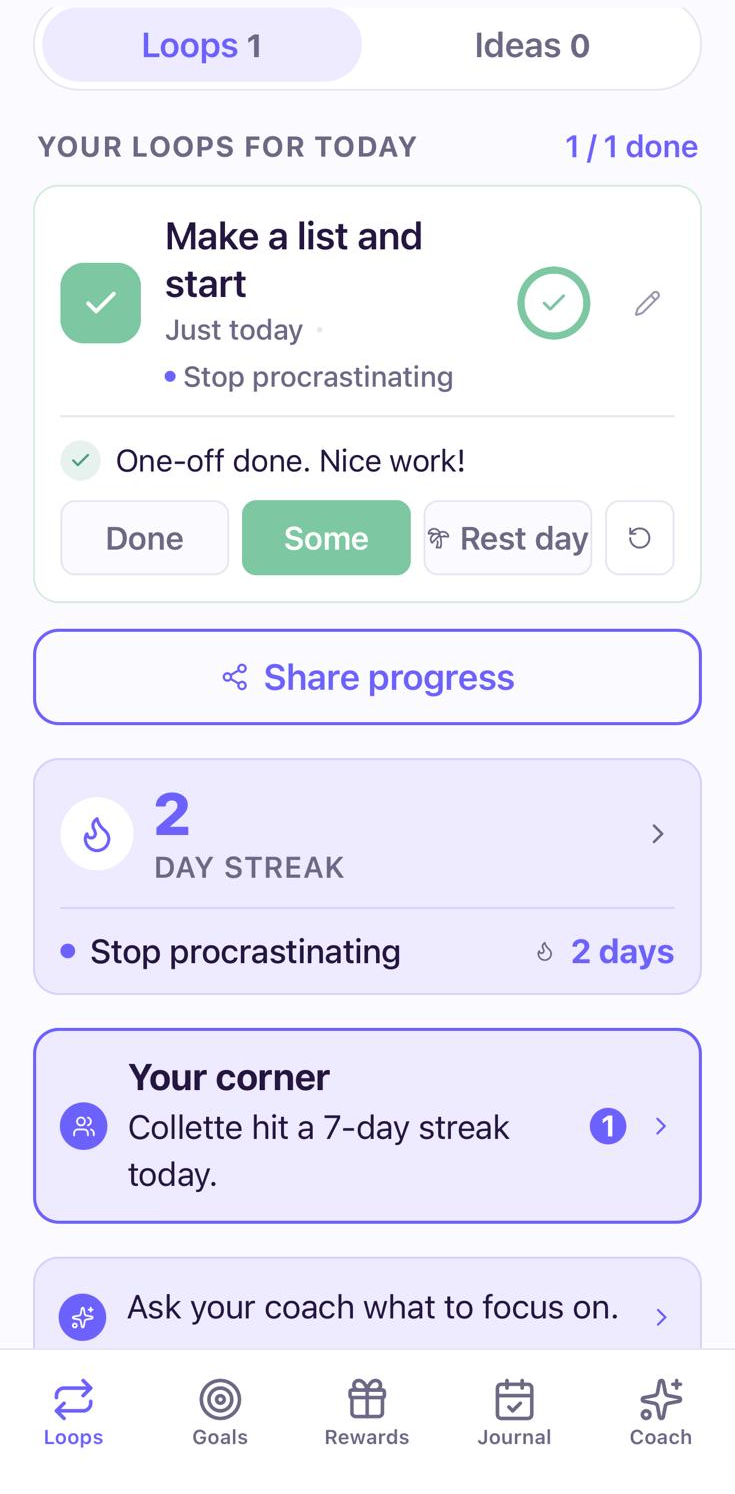
Today
Today's loops in one list. Mark it done, some, or a rest day, and see what your corner is up to.
How Loops helps
A daily system built for the hardest stretch, not the easy one.
You don't need a plan for getting your life back on track all at once. You need today to feel slightly more possible than yesterday did.
Loops offers small, low-effort actions each day, gentle support for the self-blame that often follows loss, and space to move at whatever pace this actually takes.
Then there's the part most apps leave out. One person, quietly alongside you. More on that just below.
Does any of this sound familiar?
You're not alone in this.
These are the patterns people with ADHD describe most often while healing after a loss. If you see yourself here, you're in the right place.
You're harder on yourself for “not coping better” than you'd ever be on someone else.
A small piece of criticism or a missed task can feel disproportionately devastating right now.
You've tried to push through with sheer effort, and it's left you more exhausted, not less.
Part of you worries that needing extra support means you're handling this badly.
Even after some time has passed, things don't feel like they're getting easier the way you expected.
None of this means you're grieving wrong. It means grief and ADHD are compounding each other, and that takes more support, not less of it.
Understanding the pattern
It's not a personal failure. It's two systems under strain at once.
Grief alone affects concentration, memory, and motivation. ADHD affects those same areas on an ordinary day. Together, they can make basic functioning genuinely harder, not just harder to feel motivated about.
- 01
The collapse gap
Grief and ADHD both draw on the same mental resources. When they hit together, planning, memory, and follow-through can all become harder at once, not just feelings.
- 02
The activation gap
Knowing what you should do becomes much harder to act on after a loss. A missed task often isn't carelessness. It's the cost of starting going up while your resources go down.
- 03
The shame gap
Struggling after loss can quickly turn into “I am failing at this too.” That belief adds pressure exactly when you have the least capacity to carry it.
- 04
The criticism gap
Small criticisms or setbacks can feel disproportionately painful while you're already grieving. That heightened sensitivity is common, not a sign you're being overly dramatic.
- 05
The perfectionism gap
Pushing through on willpower alone can look like coping from the outside. It often runs out quietly, leaving more exhaustion behind than it solved.
None of these gaps mean you're handling this badly. They mean two demanding processes are happening at once, and that deserves real support.
Something worth knowing
A late diagnosis can be its own kind of loss.
For some people, the loss this page is about isn't a bereavement or a breakup. It's the grief that can follow an ADHD diagnosis later in life: looking back at years of struggle, masking, or self-blame, and realising it had a name the whole time.
That grief is real, and it's easy to assume a diagnosis should feel like an ending rather than a beginning. It's more often the start of understanding yourself differently, not a finish line you should have already crossed.
The part most apps miss
Brains cope better with people, not with apps.
Grief can be terribly isolating. People stop asking how you are, the world moves on, and you're left doing the quiet, heavy work of ordinary days mostly on your own.
So Loops offers you, gently, the one thing that helps ADHD brains most. Another person.
You choose one person you trust. Your partner, a friend, whoever feels safe. When you manage the one small thing, they see it. Not to check up on you. Just so you're not carrying every day of this entirely alone. You decide exactly what they can see, and you can change it any time.
This part is always optional, and there's no pressure to use it. It also isn't a substitute for real support: a good friend, a grief counsellor, or your doctor matters more than any app.
You don't have to carry it alone.
Not carrying every day alone
When you manage the one small thing, they see it. Not to check up on you. Just so you're not carrying every day of this entirely alone.
They expect nothing
They don't nag, they don't manage you, they don't even pay. They're just there, quietly, on the days that feel like too much.
Always optional, always yours
You choose who it is. You decide exactly what they can see, and you can change it any time. There's no pressure to use it at all.
Not a substitute for real support
Being witnessed, even a little, can make the heaviest stretch a fraction lighter. But a good friend, a grief counsellor, or your doctor matters more than any app.
And if you'd rather keep everything to yourself for now, that's completely okay. Solo works on its own. Your person is there for if and when you want it.
Getting started
Simple from day one.
You don't need to feel ready to start. Loops is built to meet you exactly where things are right now.
- 1Step 1
Tell Loops what feels hardest right now
Name the loss, however you'd describe it, and what's felt out of reach since it happened.
- 2Step 2
Choose your person, if you want one
This one is completely optional, and it's fine to skip it for now and come back later. If you'd like someone alongside you, pick one person you trust to see the small things you manage. You decide exactly what they can see, and you can change it any time. There's nothing for them to manage, and nothing for you to keep up.
- 3Step 3
Get small daily actions
Gentle, low-effort steps each day, sized for how things actually feel. Manage it, and if you've chosen someone, your person sees it.
- 4Step 4
Get support when self-blame shows up
Quick, kind responses for the moments grief turns into “I'm failing at this.”
- 5Step 5
Move at your own pace
No fixed timeline. Some days will need less than others, and that's expected.
You don't need to feel ready. You just need today's small step.
What's inside Loops
A few simple things, working together, as gently as you need.
01
One goal, held lightly
You don't need a big goal right now. Just name what feels hardest, and what's felt out of reach since the loss. Loops holds it lightly, so there's something small to come back to, at whatever pace this takes. No timeline.
02
Loops that fit the day you're having
A loop is one small, repeating action, sized to how heavy the day feels. On the hardest days it's tiny: reply to one message, eat something, step outside for a minute. On easier days, a little more. A few connect to steadying yourself. Others are just life, like taking your meds before breakfast. There's no streak to keep and nothing to catch up on. If today wasn't possible, the next small thing is still there, whenever you're ready.
03
Your person, if you want one
Someone you choose to see the small things you manage, without expecting more. It's not there to check up on you, and it's completely optional.
04
Rewards, as kindness not targets
Promise yourself something gentle, for when you want it. Not a milestone to hit. Just a small, kind thing waiting for you: a favourite meal, an afternoon with no obligations, time somewhere that helps. Loops holds it, with no pressure and no deadline.
05
A coach who knows your whole story
An AI coach built for ADHD. It already knows what you're carrying, so there's no re-explaining yourself from the start. No booking, no waiting room. When self-blame shows up and the smallest task feels impossible, it's there with a kind response and one gentle next step. Not a pep talk, not a plan.
What people say
From people who recognise themselves in this.
After my dad died, I couldn't do the basics for weeks. I was so hard on myself about it. Having something this gentle helped me stop adding to my own pain.
After a bereavement
Diagnosed with ADHD at 29
My diagnosis came after years of struggling. I didn't expect to grieve it, but I did. This helped me process that instead of just pushing past it.
After a late diagnosis
Using Loops for 3 months
I pushed through my redundancy on pure willpower and crashed hard afterwards. This time I had something that didn't ask for that.
Marketing consultant, Glasgow
Pricing
Choose your plan
One small subscription for the coach, the loops and the streaks. Or buy credits when you need them and nothing else.
- 100 coach messages every month. Free gets 30.
- Nothing rolls over, nothing is wasted. It just resets.
- Cancel anytime.
Loops Solo
Monthly$6.99/ month
1 week free, then $6.99 a month.
Your coach, your loops and your streaks. Month to month, cancel whenever.
Loops Solo
Annual$42.99/ year
Works out at $3.58 a month.
Your coach and your streaks, for a year. Roughly half the monthly price.
Or top up
One-off packs. These credits never expire.
100
credits
100 coach message credits
$3.99
300
credits
300 coach message credits
$9.99
1,000
credits
1,000 coach message credits
Best rate
$29.99
Every plan starts with a week free. On iPhone and Android.
A few things worth knowing
Common questions before you start
“Shouldn't I be able to get through this on my own by now?”
Needing support isn't a sign you're handling this badly. Grief alongside ADHD is genuinely harder to manage with willpower alone, and getting support earlier tends to help more, not less.
“Do I have to share this with anyone?”
No. Solo works perfectly well on its own, and this can stay completely private. If and when you'd like someone alongside you, they add nothing for you to keep up, they just see the small things you choose to share. You decide what your person sees, and you can add them whenever you're ready, or not at all.
“What if I'm not grieving the 'right' way?”
There isn't a right way to grieve. Loops doesn't ask you to grieve on a particular timeline or in a particular order, just to take one small step on the days you can.
“Is this a replacement for grief counselling or therapy?”
No. Loops can help with the small daily things that get harder after a loss, but it isn't therapy and doesn't replace it. Grief counselling and therapy can help in ways an app simply cannot, and if you're able to reach for that kind of support, it's genuinely worth it. Loops is happy to sit alongside it.
“What if I'm having thoughts of harming myself?”
Please treat that as a reason to reach out for real support now, not later. If you're having thoughts of harming yourself, contact your doctor or a crisis line, or if you're in immediate danger, your local emergency number. You'll find options wherever you are on Find help now. This is bigger than anything an app can hold, and you deserve a person on the other end of it.
FAQ
Questions people often ask
Still wondering if Loops fits how your brain works? Contact us. A real person will reply.
What is Loops?
Loops is a daily coaching app for people with ADHD and anyone building better habits. For healing after loss, it offers small daily actions, gentle support for self-blame, and space to move at your own pace.
How does Loops help with healing after loss if you have ADHD?
It breaks the day into one manageable, low-effort step, offers gentle support when grief turns into self-blame, and doesn't impose a fixed timeline for recovery.
Why does loss feel so much harder to function through with ADHD?
Grief and ADHD both affect concentration, memory, and motivation. When they happen together, everyday tasks can become genuinely harder, separately from how much someone wants to cope.
Do I need an ADHD diagnosis to use Loops?
No. Loops is designed first for people with ADHD but doesn't require a formal diagnosis. If the patterns on this page feel familiar, Loops is built for you.
Is this a replacement for grief counselling or therapy?
No. Loops offers gentle daily support and works well alongside therapy or counselling, not instead of it.
How long does it take to feel better?
There's no fixed timeline, and it's not something Loops can predict. Some people notice small things feeling more manageable within a few weeks, while healing itself takes as long as it takes.
Is Loops available in the UK?
Yes. Loops is available across the UK.
One small thing today
One small thing today. Not healing on a schedule.
You don't need to be ready to feel better. You need one gentle, manageable step for today, and, if you want, one person quietly alongside you.
Get Your Account, Free Forever Today.
*Terms and Conditions Apply.
*Terms and Conditions Apply.
New to Loops? It's a free ADHD app built around small daily steps, and almost everything in it costs nothing.
If you need more support than this right now, please speak to your doctor or find a crisis line on Find help now.
Our sources
Where this comes from
This page draws on grief research, adult ADHD studies on emotional regulation and self-esteem, and real accounts of healing after loss, including the grief that can follow a late diagnosis. Here's where it comes from.
- From ADHD Diagnosis to Meaning: Does Grief Theory Enhance Our Understanding of Narrative Reconstruction? — PMC
- The Important Role of Executive Functioning and Self-Regulation in ADHD — Russell Barkley
- Attention Deficit Hyperactivity Disorder: Diagnosis and Management — NICE
- Grieving as a Form of Learning: Insights From Neuroscience Applied to Grief and Loss — PMC
- Emotion Dysregulation in Adults With Attention Deficit Hyperactivity Disorder: A Meta-Analysis — BMC Psychiatry
- Cognitive Functioning in Complicated Grief — PMC
- A Systematic Review of Lived Experiences of Receiving a Diagnosis of ADHD in Adulthood — Journal of Attention Disorders
- Adult ADHD-Related Poor Quality of Life: Investigating the Role of Procrastination — PubMed
- Self-Esteem in Adults With ADHD Using the Rosenberg Self-Esteem Scale: A Systematic Review — PubMed
- Any Other Late-Diagnosed High Achievers/Perfectionists? — r/adhdwomen
- Rejection Sensitive Dysphoria (RSD): Symptoms & Treatment — Cleveland Clinic
- The Lived Experience of Rejection Sensitivity in ADHD: A Qualitative Exploration — PMC
- Procrastination, Perfectionism, and Other Work-Related Mental Problems: A Scoping Review — Frontiers in Psychiatry
- Effectiveness of Cognitive Behavioural-Based Interventions for Adults With ADHD: A Meta-Analysis of RCTs — PubMed
- Anyone Else Very All or Nothing? — r/adhdwomen
- Body Doubling vs Body Halving — r/ADHD
- Plain English Summary of the ADHD Taskforce Report — NHS England
- The Role of Self-Compassion in the Mental Health of Adults With ADHD — PMC
- Promoting the Translation of Intentions Into Action by Implementation Intentions — PMC
- ADHD UK — Homepage
- A Systematic Review of Interventions to Support Adults With ADHD at Work — Frontiers in Psychology
- Exploring the Lived Experience of Grief in Adults With Attention Deficit Hyperactivity Disorder — Martina Bauer, Antioch University
Loops is a daily coaching app, not a medical or clinical service. These sources inform how we think about ADHD and healing after loss; they are not an endorsement of Loops by their authors.