
You have a notes app full of ideas. Most of them will never become a post.
Designed for ADHD. Works for everyone.
You've started before. More than once. Here's why it didn't stick.
It's not that you don't have ideas, or that you don't care enough. Growing an audience asks for a kind of consistency that ADHD makes genuinely harder to give.
Loops is a daily coaching app for people with ADHD. It gives you small actions each day, an easy way back after a quiet week, and, if you want it, one person in your corner who isn't the audience you're trying to reach.
Get Your Account, Free Forever Today.
*Terms and Conditions Apply.
*Terms and Conditions Apply.
Three things Loops does for you
Sort your ideas
Turn the pile of half-formed ideas into one thing worth doing next.
Keep showing up
Small daily prompts that don't depend on motivation turning up first.
Recover from gaps
A missed week becomes a restart, not a reason to quit again.
Loops is a daily coaching app for people with ADHD.
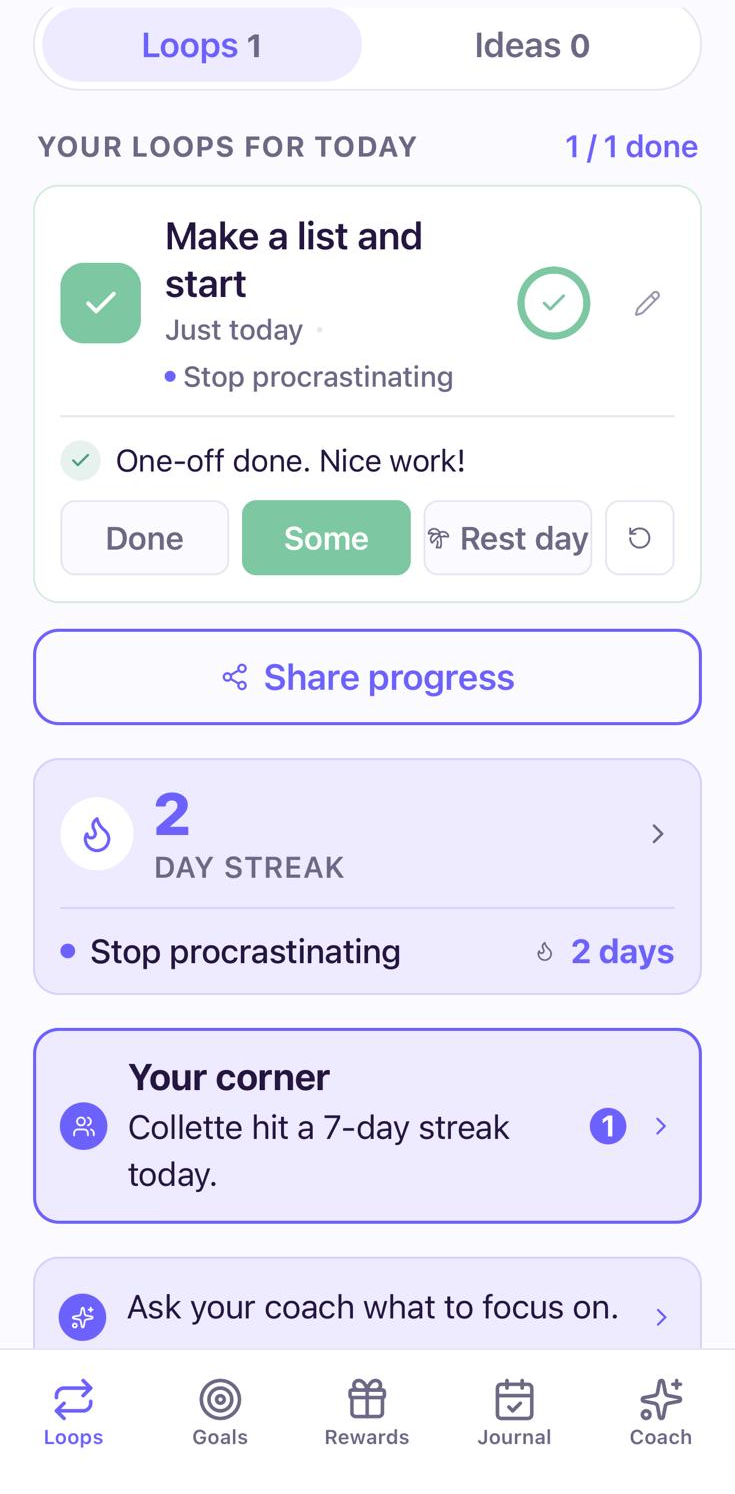
Today
Today's loops in one list. Mark it done, some, or a rest day, and see what your corner is up to.
How Loops helps
A daily system built for the part that keeps breaking.
You don't need more ideas, more platforms, or more discipline. You need the gap between intention and posting to get smaller, on the days it usually doesn't.
Loops gives you one small action each day, helps you recover quickly when a week goes wrong, and keeps your audience-building goal visible without needing you to hold it in your head.
Then it adds the part most apps leave out. One person who sees you doing it. More on that just below.
Does any of this sound familiar?
You're not alone in this.
These are the patterns people with ADHD describe most often when trying to build an audience. If you see yourself here, you're in the right place.
You post brilliantly for two or three weeks, then quietly disappear without meaning to.
You open the app to post once and somehow lose forty minutes scrolling instead.
A bit of criticism, or even silence, can knock you out of posting for days.
You've tried planners, content calendars, and trackers. They all became one more thing you abandoned.
Every restart feels heavier than the last, because you remember every time before.
None of this means you're not capable. It means the work has been fighting the way your brain actually runs.
Understanding the pattern
It's not a discipline problem. It's a mismatch.
Audience growth asks for the exact things ADHD makes least reliable: steady repetition, delayed rewards, and recovering smoothly after things go quiet. Knowing what to do has never been the missing piece.
- 01
The idea gap
You can generate ideas faster than you can sort them. A growing list of unused ideas doesn't feel like potential. It starts to feel like proof.
- 02
The switching gap
Writing, filming, editing, posting, and replying all pull on different kinds of focus. Jumping between them is exactly the kind of fragmentation that drains an ADHD brain fastest.
- 03
The reward gap
An audience that compounds in six months can't compete with right now. When the payoff is distant, it's normal for the brain to keep putting today's post off.
- 04
The shame gap
A quiet comment, or no comments at all, can feel disproportionately heavy. That sensitivity to criticism isn't oversensitivity. It's a documented part of how ADHD affects emotional regulation.
- 05
The platform trap
The app you need to post on is also the app built to keep you scrolling. The same tool is both your only way to reach people and one of the easiest places to lose an hour.
None of these gaps are fixed by trying harder. They're fixed by building around them.
Something worth knowing
The part that feels like a contradiction.
It's common to start a project, a page, or an account with real momentum, and then watch that same momentum disappear the moment it stops being new. That's not a coincidence. Some of the traits that make starting easy, like quick ideas and a pull toward novelty, are different from the traits that growth needs once the early excitement fades.
That doesn't mean ADHD makes audience growth impossible. It means the early spark and the long middle need different kinds of support, and most advice only ever talks about the spark.
The part most apps miss
Brains finish for people, not for apps.
Posting into the quiet is its own kind of lonely. You put something out, nobody replies, and the silence is easy to read as a verdict, which is exactly what makes the next post harder to send.
So Loops adds the one thing that reliably keeps ADHD brains going. Another person.
You choose one person you trust, someone whose being there feels safe. Not a follower, not the audience, just one person in your corner. When you close a loop, they see it. When you come back after a quiet week, they see that too, and it's no big deal. You decide exactly what they can see, and you can change it any time.
This is the step most people skip with other apps. It's also the one that makes Loops work.
Not the audience you're chasing
You choose one person you trust, someone whose being there feels safe. Not a follower, not the audience, just one person in your corner who's glad you're still at it.
They don't rate your posts
They don't rate your posts or count your numbers. They don't manage you, they don't even pay. Their side is light on purpose.
You're always in control
You choose who it is. You decide exactly what they can see, and you can change it any time.
Worth more than the metrics
When the metrics are silent and a comment stung, one person who's glad you're still at it is worth more than the numbers.
You can start on your own if you'd rather. It still works. It just works better when someone can see you.
Getting started
Simple from day one.
You don't need to rebuild your whole approach to content. Loops fits around what you're already trying to do.
- 1Step 1
Tell Loops what you're building
Set your audience goal in plain language. No content strategy document required.
- 2Step 2
Choose your person
Pick one person you trust, whose being there feels safe, to see your progress. Not the audience, just one person in your corner. You decide what they can see, and you can change it any time. This is the step most people skip with other apps, and the one that makes Loops work.
- 3Step 3
Get small daily actions
Short, specific things to do each day, whether that's drafting, posting, or replying. It takes minutes, not hours. Close the loop, and your person sees it.
- 4Step 4
Get support when things slip
A missed day or a hard comment doesn't need a full reset. Loops helps you pick the thread back up quickly.
- 5Step 5
Watch the small wins add up
Over weeks, the daily actions become a body of work and a steadier presence, without needing a single big push.
You don't need a perfect run. You just need today's step.
What's inside Loops
Five simple things, working together.
01
One goal, in your own words
Your audience-building goal, described your way. No content strategy document. Just a clear sense of what you're building, kept visible so you don't have to hold it in your head.
02
Loops that fit your life
A loop is one small, repeating action, at a pace you choose, that takes minutes rather than hours. Some run every day, some a few times a week: draft one idea from the pile, post the thing you already made, reply to a few people. A few connect to your goal. Others are just life, like taking your meds before breakfast. Miss one and nothing is wiped out. The next action is still there, still small, still doable.
03
Your person
The one you choose to see your progress: the loops you close and the weeks you come back after going quiet. A safe pair of eyes in your corner, not the audience, and not there to rate your posts.
04
Rewards you can feel
Because the real payoff is months away, you promise yourself something for the moments that matter now: a week you kept showing up, the comeback after a quiet stretch, the idea that finally became a post. Loops holds the promise and calls it in when you've earned it, and your person gets to see it too.
05
A coach who knows your whole story
An AI coach built for ADHD. It already knows what you're building and where you tend to drop off, so there's no re-explaining yourself from the start. No booking, no waiting room. It's there after a quiet week or a comment that stung, with a calm way back in, not a reminder of the run you broke.
What people say
From people who recognise themselves in this.
I'd started three accounts before and let them all die quietly. The daily prompts meant I had something small to do even on the weeks I didn't feel inspired. Six months in, I'm still here.
Freelance illustrator
Diagnosed with ADHD at 29
I used to disappear for two weeks after one bad comment. Loops helped me come back the next day instead of the next month.
Newsletter writer
Using Loops for 5 months
My ideas list was the problem, not the lack of them. Having one clear thing to do each day got me out of my notes app and into actually posting.
Podcast host, Bristol
Pricing
Choose your plan
One small subscription for the coach, the loops and the streaks. Or buy credits when you need them and nothing else.
- 100 coach messages every month. Free gets 30.
- Nothing rolls over, nothing is wasted. It just resets.
- Cancel anytime.
Loops Solo
Monthly$6.99/ month
1 week free, then $6.99 a month.
Your coach, your loops and your streaks. Month to month, cancel whenever.
Loops Solo
Annual$42.99/ year
Works out at $3.58 a month.
Your coach and your streaks, for a year. Roughly half the monthly price.
Or top up
One-off packs. These credits never expire.
100
credits
100 coach message credits
$3.99
300
credits
300 coach message credits
$9.99
1,000
credits
1,000 coach message credits
Best rate
$29.99
Every plan starts with a week free. On iPhone and Android.
A few things worth knowing
Common questions before you start
“I've tried tools like this before. They didn't work.”
Most tools assume the problem is organisation. Loops is built around the parts that actually break for ADHD brains, like restarting after a gap and recovering from criticism, not just scheduling posts.
“Do I have to share my progress with anyone?”
No. Solo works perfectly well on its own. If you do choose someone, they're a safe pair of eyes in your corner, not the audience, and not there to rate your posts. You decide what your person sees, and you can add them whenever you're ready.
“What if my niche or idea isn't good enough?”
That's rarely the real issue. ADHD brains are often strong at generating original ideas. The struggle is usually sustaining and finishing one, which is exactly what Loops is built to support.
“I'm worried I'll just abandon this too.”
That fear is fair, given what's happened before. Loops is built around small, low-stakes daily actions specifically because big commitments are where most systems quietly fail.
“I don't have time to learn another app.”
Loops doesn't ask for a learning curve. Setup takes a few minutes, and each day asks for one small action, not a new skill to master.
FAQ
Questions people often ask
Still wondering if Loops fits how your brain works? Contact us. A real person will reply.
What is Loops?
Loops is a daily coaching app for people with ADHD and anyone building better habits. For audience growth, it focuses on small daily actions, one person who sees your progress, recovery support after missed days, and keeping the goal visible without extra admin.
Who is 'your person', and do I need one?
Your person is the one you choose to see your progress: the loops you close and the weeks you come back after going quiet. They're a safe pair of eyes in your corner, not a follower or the audience, and not there to rate your posts or count your numbers. When the metrics are silent and a comment stung, one person who's glad you're still at it is worth more than the numbers. You don't have to add one to start, but it's the part that makes Loops work, so we'll gently encourage it when you're ready.
How does Loops help with growing an audience if you have ADHD?
It breaks audience growth into one manageable daily step. It helps you recover quickly after a missed day or a tough comment. And it keeps your goal visible so you're not relying on memory or motivation alone.
Why do people with ADHD struggle to grow an audience even with good ideas?
The barriers are usually structural rather than personal: difficulty sustaining motivation toward a distant payoff, getting fragmented across different tasks, and finding it hard to recover after criticism or a missed streak. All of these respond well to the right kind of support.
Do I need an ADHD diagnosis to use Loops?
No. Loops is designed first for people with ADHD but doesn't require a formal diagnosis. If the patterns on this page feel familiar, Loops is built for you.
Will Loops help me go viral?
No, and that's not really what it's for. Loops is built to help you keep showing up consistently, which is what most lasting audiences are actually built from.
I've abandoned audience-building attempts before. Will this be different?
We can't promise certainty, but Loops is built specifically around the moments where past attempts usually broke down, like missed days and quiet weeks, rather than assuming a clean run.
How long does it take to see results?
Some people notice a difference in how posting feels within the first couple of weeks. A noticeably steadier audience usually takes a few months of small, repeated steps.
Is Loops available in the UK?
Yes. Loops is available across the UK.
Today's post
You don't need a comeback. You need today's post.
You've already proved you can start. The next step is making the next one a little easier than the last, and, if you want, one person in your corner while you take it.
Get Your Account, Free Forever Today.
*Terms and Conditions Apply.
*Terms and Conditions Apply.
New to Loops? It's a free productivity app built around small daily steps, and almost everything in it costs nothing.
Our sources
Where this comes from
This page draws on ADHD clinical guidelines, research into executive function, emotion regulation and delayed reward, and real accounts from people with a private tally of unfinished accounts and abandoned content calendars. Here's where it comes from.
- ADHD, Executive Function and Self-Regulation — Russell Barkley
- CBT for Adult ADHD: From Intention to Action — Psychwire
- Creativity in ADHD: Goal-Directed Motivation and Domain-Specific Understanding — PubMed
- Evaluating Digital Interventions for ADHD Diagnosis and Management — Strathprints
- Understanding Procrastination — Aarhus University
- Evidence of Emotion Dysregulation as a Core Symptom of Adult ADHD: A Systematic Review — PLOS One
- Strengths and Challenges to Embrace Attention-Deficit/Hyperactivity Disorder in Employment — Sage Journals
- Does Anyone Have Suggestions on How an Adult With ADHD Can Avoid Feeling Overwhelmed? — r/gtd
- How I Create Content as Someone With ADHD: 7 Tactics + Tools I Lean On — Buffer
- Self-Compassion and Perceived Criticism in Adults With ADHD — PubMed
- She Wrote the Book on Women, Shame, and ADHD — Understood.org
- ADHD in Adults — NHS
- Why Are All These ADHD “Help” Tools Overwhelming? — r/adhdwomen
- ADHD-Friendly Content Strategy Pending... — r/content_marketing
- The Efficacy of Cognitive Behavioral Therapy for Adults With ADHD — PubMed
- A Systematic Review of Interventions to Support Adults With ADHD at Work — Frontiers
- Arousal Dysregulation and Executive Dysfunction in ADHD — Frontiers
- Attention Deficit Hyperactivity Disorder: Diagnosis and Management — NICE
- Creativity and ADHD: A Review of Behavioural Studies, Psychostimulants and Neural Underpinnings — Utrecht University
- A Meta-Analysis of Pharmacological and Psychosocial Interventions for Work-Relevant Outcomes in Adults With ADHD — Sage Journals
Loops is a daily coaching app, not a medical or clinical service. These sources inform how we think about ADHD and growing an audience; they are not an endorsement of Loops by their authors.