
You have a trail of things that are almost done. Not abandoned. Just never quite finished.
Designed for ADHD. Works for everyone.
You start things well. So why is everything still 80% done?
It's not that you can't do the work. You clearly can. For many people with ADHD, the finish is the hardest part, because it's the part with no reward left in it.
Loops is a daily coaching app for people with ADHD. It gives you small steps toward done each day, coaching for when a new idea pulls at you, and, if you want it, one person waiting for you to finish.
Get Your Account, Free Forever Today.
*Terms and Conditions Apply.
*Terms and Conditions Apply.
Three things Loops does for you
Get through the last part
The unrewarding final stretch is exactly what Loops is built for.
One thing carried to done
Not ten things at 80%. One thing, all the way.
Actually finished
Closed, done, off the list. Not just nearly there.
Loops is a daily coaching app for people with ADHD.
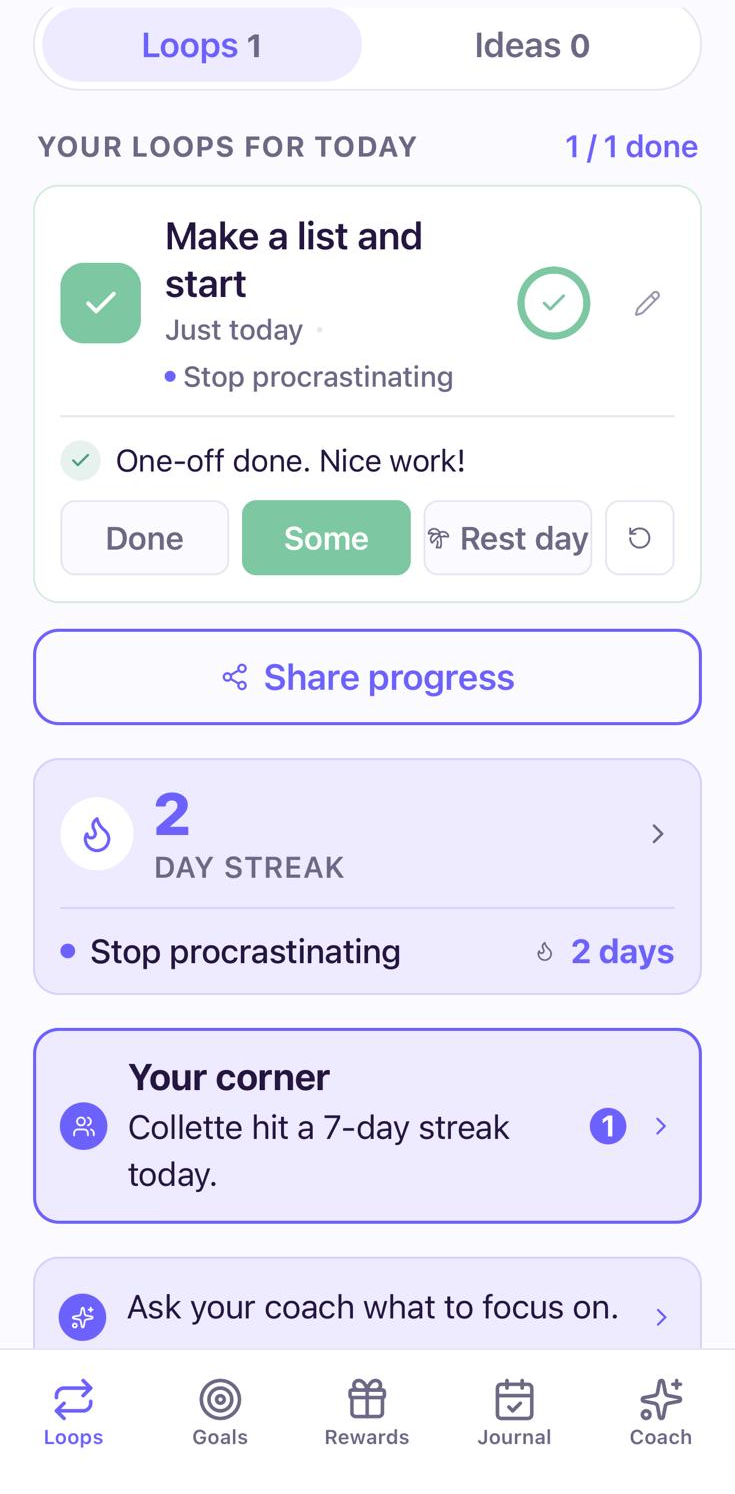
Today
Today's loops in one list. Mark it done, some, or a rest day, and see what your corner is up to.
How Loops helps
A daily system for the last part, not the exciting first part.
Most productivity tools help you start. Starting was never your problem. The problem is the stretch between mostly-done and actually-finished, where the interest has gone and a newer, shinier thing is pulling at your attention.
Loops gives you specific actions each day on the thing that's closest to done, keeps it visible when a new idea tries to replace it, and coaches you through the unrewarding final stretch. Not a fresh start. A finish.
Then it adds the part most apps leave out. One person who sees you doing it. More on that just below.
Does any of this sound familiar?
You're not alone in this.
These are the patterns people with ADHD describe most often when it comes to finishing things.
The exciting part is the beginning. By the time the end arrives, the energy that started it is long gone.
You finish the hard 90%. The boring last 10% is the part that never happens.
A new idea always seems to arrive right when the current thing needs its final, least interesting push.
You keep the almost-finished things around because finishing them feels strangely harder than starting new ones.
You know you're capable. The evidence is everywhere, in all the things that are nearly, but not quite, complete.
A trail of nearly-finished things isn't evidence that you can't do it. It's evidence that you can, and that the finish is a different problem from the start.
Understanding the pattern
It's not that you give up. It's that the end is built differently from the start.
Finishing breaks down for ADHD brains through a specific set of mechanisms. Understanding them matters, because the finish needs different support from the start.
- 01
The finish line has no reward
Starting produces a dopamine hit. Finishing rarely does. ADHD brains are driven by novelty and immediate reward, and the final stretch of any task is usually the least novel and least stimulating part, which means the brain stops supplying the motivation that made the start feel easy.
- 02
The 90% done trap
Once something is mostly done, it stops feeling urgent. The problem is solved in your head, even though it isn't solved in reality. ADHD's difficulty with future consequences means a nearly-finished thing quietly drops down the priority list until it's forgotten entirely.
- 03
The next-idea pull
A new idea always feels more alive than an old one that's nearly done. The novelty of the next thing competes directly with the last unrewarding push on the current thing, and novelty usually wins. This isn't flightiness. It's how ADHD attention allocates itself.
- 04
Perfectionism at the end
Sometimes the last 10% doesn't get done because finishing means judging it. As long as it's unfinished, it can't be evaluated. For ADHD brains where setbacks land hard, leaving something almost-done can be a way of protecting it, and yourself, from a verdict.
- 05
No external deadline
The things that get finished usually have someone waiting. The things that don't are the ones only you are tracking. Without an external structure holding the finish in place, the final push depends entirely on internal motivation, which is exactly what runs out at the end.
Loops is designed to hold the finish in place when internal motivation can't.
Something worth knowing before you start anything new
Finishing isn't a smaller version of starting. It's the opposite task.
Starting is novel, open-ended, and full of possibility, which is exactly what ADHD brains find rewarding. Finishing is repetitive, constrained, and final, which is exactly what they don't. Treating them as the same kind of effort is why "just push through to the end" so rarely works.
The finish needs its own structure: an external prompt that keeps the nearly-done thing visible, a next action small enough to survive the missing reward, and something holding the deadline that isn't only your own fading interest. Not more willpower. A different scaffold for a different task.
The part most apps miss
Brains finish for people, not for apps.
Here's the pattern, in one line: the things that get finished usually have someone waiting. The things that don't are the ones only you were ever tracking.
So Loops adds the one thing that reliably keeps ADHD brains going, and it's the exact thing a nearly-done project is missing. Another person.
You choose one person you trust. Your partner, a friend, whoever it is. When you close a loop, they see it. When the thing is finally done, they see that too. You decide exactly what they can see, and you can change it any time.
This is the step most people skip with other apps. It's also the one that makes Loops work.
All they have to do is see it
When you close a loop, they see it. When the thing is finally done, they see that too. They just get to watch you carry the thing all the way to done, and cheer you on.
They don't chase you
They don't have to nag you or chase you. They don't manage you, they don't even pay. Their side is light on purpose.
You're always in control
You choose who it is. You decide exactly what they can see, and you can change it any time.
The finish isn't only yours
Suddenly the finish isn't only yours to hold. Someone's waiting, and that is often the whole difference between 90% and done.
You can start on your own if you'd rather. It still works. It just works better when someone can see you.
Getting started
One action toward done. Every day. Until it's finished.
You don't need a new project. You need to close one of the ones you already have.
- 1Step 1
Tell Loops what's nearly done
Name the thing that's closest to finished, or the one that's been unfinished longest. Plain language. No categories, no setup that becomes its own project.
- 2Step 2
Choose your person
Pick one person you trust to see your progress, so the finish is not only yours to hold. You decide what they can see, and you can change it any time. This is the step most people skip with other apps, and the one that makes Loops work.
- 3Step 3
Get small daily actions
Each day, Loops gives you specific, low-friction steps on the finish, not the start. Small enough to do without the reward that's already gone. Targeted at closing, not reopening. Close the loop, and your person sees it.
- 4Step 4
Get coached when the new idea calls
Feeling the pull of a shinier thing? Loops keeps the nearly-done thing in front of you and gives you a way to keep going, so the current thing gets finished before the next one begins.
- 5Step 5
Actually finish it
Not perfectly. Not endlessly polished. Done. Off the list. And then, if you want, the next one, with the same structure holding it to the end.
You don't need the enthusiasm you started with. You need one small step toward done.
What's inside Loops
Five simple things, working together.
01
One goal, with a finish line
The one thing you want to finish, in your own words: the nearly-done thing, or the one that's sat unfinished longest. The finish line is the whole point here, so Loops keeps it in front of you until it's actually done.
02
Loops that fit your life
A loop is one small, repeating action, at a pace you choose, aimed at the finish rather than the start. Small enough to do without the reward that's already gone. Some run every day, some a few times a week: the next paragraph, the boring last section, the email that sends it out the door. A few connect to the thing you're finishing. Others are just life, like taking your meds before breakfast. A missed one doesn't wipe you out. You can repair a streak simply by showing up again.
03
Your person
The one you choose to see your progress, so the finish isn't only yours to hold: the loops you close and the moment it's finally done. Support, without the nagging or the chasing.
04
Rewards you can feel
Promise yourself something for the moments that matter: the last 10% finally done, a thing off the pile for good, the first finish in longer than you'd like to admit. Loops holds the promise and calls it in when you've earned it, and your person gets to see it too.
05
A coach who knows your whole story
An AI coach built for ADHD. It already knows what you're finishing and where you tend to drift, so there's no re-explaining yourself from the start. No booking, no waiting room. It's there when a shinier idea is pulling at you, holding the nearly-done thing in front of you with the next small step to done.
What people say
From people who recognise themselves in this.
I had eleven things sitting at about 90% done. I told Loops about the oldest one and it just kept handing me the next tiny step. I finished it in nine days. I hadn't finished anything in about a year.
Product designer
Diagnosed with ADHD at 34
The last 10% was always where things died for me. Loops didn't make it interesting. It just made it possible to keep going without the interest. That was the whole thing I'd been missing.
Freelance copywriter
Using Loops for 7 weeks
I finished it. It's done. For once there's no half-finished version of it haunting me. I didn't realise how much those were weighing on me until this one wasn't.
PhD student, Manchester
Pricing
Choose your plan
One small subscription for the coach, the loops and the streaks. Or buy credits when you need them and nothing else.
- 100 coach messages every month. Free gets 30.
- Nothing rolls over, nothing is wasted. It just resets.
- Cancel anytime.
Loops Solo
Monthly$6.99/ month
1 week free, then $6.99 a month.
Your coach, your loops and your streaks. Month to month, cancel whenever.
Loops Solo
Annual$42.99/ year
Works out at $3.58 a month.
Your coach and your streaks, for a year. Roughly half the monthly price.
Or top up
One-off packs. These credits never expire.
100
credits
100 coach message credits
$3.99
300
credits
300 coach message credits
$9.99
1,000
credits
1,000 coach message credits
Best rate
$29.99
Every plan starts with a week free. On iPhone and Android.
A few things worth knowing
Common questions before you start
“I've got so many unfinished things I don't know where to start.”
You don't have to sort all of them. Pick one, the oldest or the closest to done, and let Loops handle the rest. Finishing one changes how the others feel, and Loops moves on to the next when you're ready.
“Do I have to share my progress with anyone?”
No. Solo works perfectly well on its own. But most people find it works better when one person can see them, since a finish with someone waiting is far more likely to happen. You decide what your person sees, and you can add them whenever you're ready.
“Isn't it easier to just start fresh?”
It feels easier, because starting is the rewarding part. But a new start becomes another nearly-done thing on the pile. Finishing one is what breaks the pattern, and it's usually far less work than beginning again.
“What if I'm not diagnosed?”
You don't need a diagnosis. Many people using Loops are on waiting lists, self-identifying, or simply recognise that the patterns here feel familiar. If that's you, Loops is built for you.
“Won't one small step a day take forever to finish anything?”
It's faster than it sounds, because the last stretch is usually smaller than it feels. One daily step on the thing that's nearly done tends to close it in days or weeks, not the months it's already been sitting there.
FAQ
Questions people often ask
Still wondering if Loops fits how your brain works? Contact us. A real person will reply.
What is Loops?
Loops is a daily coaching app for people with ADHD and anyone building better habits. It combines personalised coaching, daily micro-actions, one person who sees your progress, and accountability in one system. For finishing specifically, it helps with the final stretch of a task, where the reward has gone and a new idea is competing for attention.
Who is 'your person', and do I need one?
Your person is the one you choose to see your progress: the loops you close and the moment it's finally done. They don't chase you or nag you. The things that get finished usually have someone waiting, so having one person makes the finish far more likely. You don't have to add one to start, but it's the part that makes Loops work, so we'll gently encourage it when you're ready.
How does Loops help me finish things if I have ADHD?
It gives you one specific action each day on the thing that's closest to done, keeps it visible when a new idea pulls at you, and coaches you through the unrewarding final part. It's designed for the finish, not the start.
Why do people with ADHD struggle to finish what they start?
Starting produces a dopamine response and finishing rarely does. The final stretch of any task is the least novel and least stimulating part, so the brain stops supplying the motivation that made starting easy. Add the pull of new ideas and the lack of an external deadline, and the end becomes far harder than the beginning.
Is this different from a to-do app?
Yes. A to-do app shows you everything unfinished, which for many ADHD brains adds to the overwhelm. Loops gives you one action on one thing, so finishing feels possible rather than buried under everything else you haven't done.
Do I need an ADHD diagnosis to use Loops?
No. Loops is designed first for people with ADHD but doesn't require a formal diagnosis. If the experiences described here feel familiar, Loops is built for you.
What if I keep getting pulled toward new projects?
That's expected, and Loops is built for it. It keeps the nearly-done thing in front of you so the next idea doesn't quietly replace it. You can capture the new idea for later without abandoning the current finish.
What if I miss several days?
That's built into the design. Loops doesn't treat a missed week as a reason to start over. The next action toward finishing is still there, still small, and still designed to be the easiest possible step back in.
Is Loops available in the UK?
Yes. Loops is available across the UK and is designed around UK contexts and guidance.
One thing, finished
Pick one nearly-done thing and actually finish it.
Not all of them. Not perfectly. Just one, carried all the way to done, so it stops sitting there, and, if you want, one person waiting at the finish.
Get Your Account, Free Forever Today.
*Terms and Conditions Apply.
*Terms and Conditions Apply.
New to Loops? It's a free productivity app built around small daily steps, and almost everything in it costs nothing.
Our sources
Where this comes from
This page draws on ADHD clinical guidelines, research into executive function, emotion regulation and completion behaviour, and real accounts from people with a trail of unfinished work. Here's where it comes from.
- Attention deficit hyperactivity disorder: diagnosis and management — NICE
- Functional Impairment and Quality of Life in Newly Diagnosed Adults With ADHD — PubMed
- Executive Functioning in Adult ADHD: A Meta-Analytic Review — PubMed
- Complex Prospective Memory in Adults With Attention Deficit Hyperactivity Disorder — PMC
- Increased Default-Mode Variability Is Related to Reduced Task Engagement — PMC
- The Important Role of Executive Functioning and Self-Regulation — Russell Barkley
- Emotional Dysregulation and Attention-Deficit/Hyperactivity Disorder — PMC
- Stress and Work-Related Mental Illness Among Working Adults With ADHD: A Qualitative Study — Springer
- The Lived Experiences of Adults With Attention-Deficit/Hyperactivity Disorder: A Rapid Review of Qualitative Evidence — Frontiers
- Adult ADHD-Related Poor Quality of Life: Investigating the Role of Procrastination — ResearchGate
- A Systematic Review and Component Network Meta-Analysis of ADHD Interventions — PubMed
- Short-Term and Long-Term Effect of Non-Pharmacotherapy for Adults With ADHD: A Systematic Review and Network Meta-Analysis — Frontiers
- Evaluating the Evidence: A Systematic Review of Reviews of Digital Interventions for ADHD — Springer
- Coaching for Adults With ADHD: A Prospective Study — PMC
- Why Doesn't a Planner Work? — r/ADHD
- Proposing Body Doubling as a Continuum of Space/Time Co-presence — leyabreanna.com
- Misinformation Mayhem: The Effects of TikTok Content on ADHD Knowledge and Confidence — Springer
- “Turning Intentions Into Actions” — J. Russell Ramsay, Sage Journals
- Assessment of Goal-Directed Behavior and Prospective Memory in Adult ADHD With an Online 3D Videogame Simulating Everyday Tasks — Nature
- Evidence of Emotion Dysregulation as a Core Symptom of Adult ADHD — PMC
- Experience of CBT in Adults With ADHD: A Mixed Methods Study — Frontiers
- Digital Health Technologies for Adults With ADHD: A Scoping Review — Frontiers
- The Experience of Effort in ADHD: A Scoping Review — Frontiers
- My Childhood Bedroom Is a Graveyard of Unfinished Crafts... — r/ADHD
- Report of the Independent ADHD Taskforce: Part 2 — NHS England
- Systematic Review and Meta-Analysis: Effects of Pharmacological Treatment for ADHD on Quality of Life — ScienceDirect
Loops is a daily coaching app, not a medical or clinical service. These sources inform how we think about ADHD and finishing what you start; they are not an endorsement of Loops by their authors.