
You read a message, mean to reply properly, and then it sits unanswered for days.
Designed for ADHD. Works for everyone.
You care more than your follow-through shows. Here's why that gap keeps happening.
Forgotten replies, missed plans, and late apologies don't mean you don't care. They're a sign that the part of relationships ADHD makes hardest is the part nobody warned you about.
Loops is a daily coaching app for people with ADHD. It gives you small daily actions, support for the moments a small friction feels huge, and, if you want it, one person quietly in your corner.
Get Your Account, Free Forever Today.
*Terms and Conditions Apply.
*Terms and Conditions Apply.
Three things Loops does for you
Follow through more often
Small daily nudges that help you reply, remember, and show up.
Stay steadier under friction
Support for the moments small things start to feel huge.
Repair before shame takes over
A quick way back in after a slip, before avoidance makes it worse.
Loops is a daily coaching app for people with ADHD.
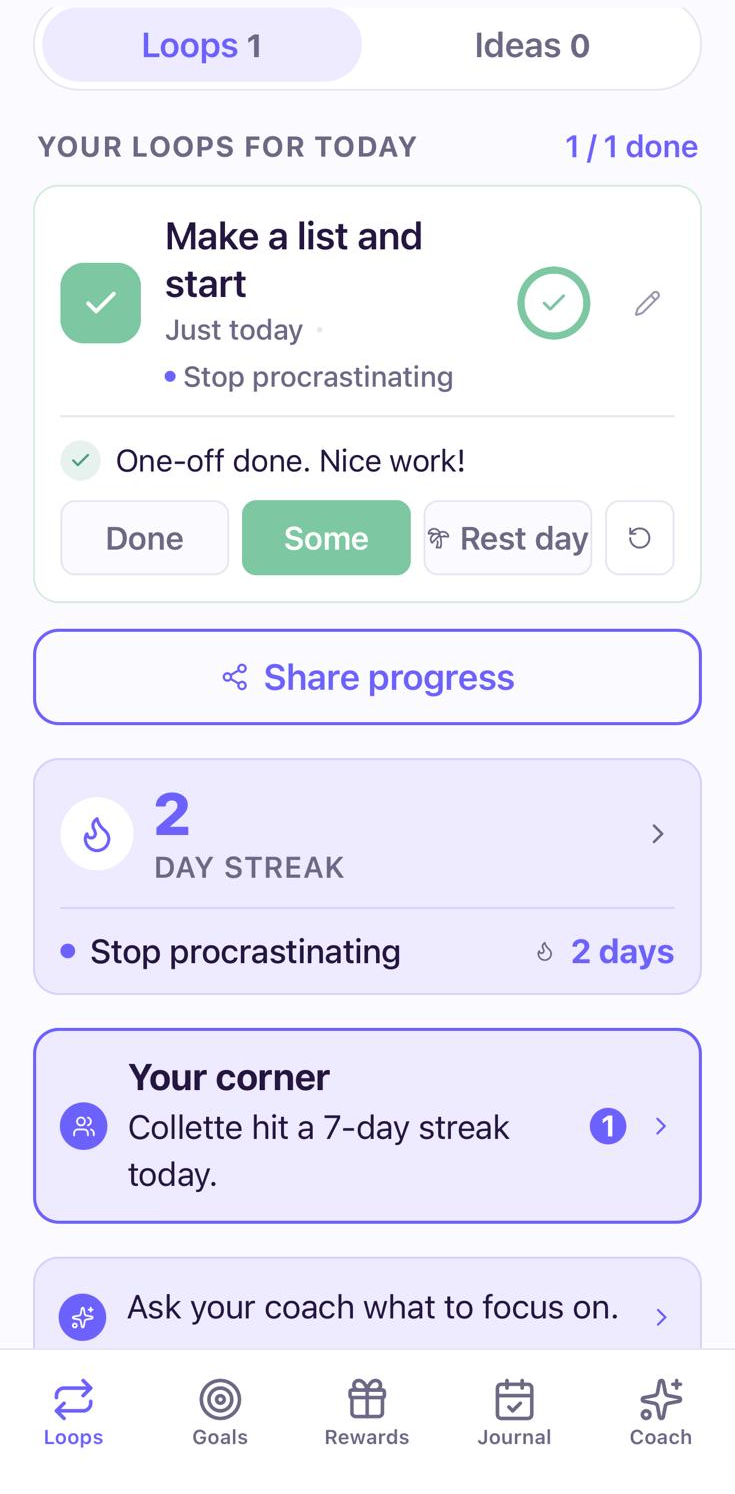
Today
Today's loops in one list. Mark it done, some, or a rest day, and see what your corner is up to.
How Loops helps
A daily system built for the part relationships actually test.
You don't need to want it more. You need the gap between meaning to reply, remember, or show up, and actually doing it, to get smaller.
Loops gives you small daily actions, support for the moments a small friction starts to feel overwhelming, and a quick way to repair after a slip, before shame turns it into something bigger.
Then it adds the part most apps leave out. One person quietly alongside you. More on that just below.
Does any of this sound familiar?
You're not alone in this.
These are the patterns people with ADHD describe most often in close relationships. If you see yourself here, you're in the right place.
A small comment from someone you love can knock you sideways for the rest of the day.
You've forgotten a plan, a date, or a promise you genuinely meant to keep.
You sometimes avoid opening a message because you already feel bad about not replying sooner.
A partner or friend has become the one who reminds you of things, and you both feel worse about it.
You showed up intensely at the start of a relationship and worry the same focus won't last.
None of this means you love people less. It means the follow-through side of relationships needs more support than most advice accounts for.
Understanding the pattern
It's not a caring problem. It's a follow-through problem.
Relationships run on small, repeated actions: replying, remembering, noticing, and showing up steadily. ADHD affects exactly those things, separately from how much you care.
- 01
The follow-through gap
Meaning to reply isn't the same as actually replying. A forgotten message often isn't a sign of low priority. It's a sign the moment to act on it slipped past.
- 02
The amplification gap
A small friction can land as a much bigger emotional event. That's not oversensitivity. It's a documented part of how ADHD affects emotional regulation under pressure.
- 03
The attunement gap
Reading the room is sometimes effortless and sometimes genuinely hard, depending on load. The same person can seem deeply present one day and distracted the next, without either being the “real” version.
- 04
The shame-avoidance gap
A small mistake can trigger enough shame to make the message harder to open. Avoidance usually grows the problem it was trying to escape.
- 05
The reminder-resentment gap
When a partner becomes the reminder system, both people end up unhappy. One feels managed, the other feels like the only one keeping track.
None of these gaps mean the relationship is doomed. They mean the follow-through side needs its own support, separate from how much you feel.
Something worth knowing
The intense start and the quieter middle need different things.
It's common to show up for someone with total focus at the start of a relationship or friendship, full attention, constant contact, deep interest, and then feel that intensity fade once things become familiar. That drop can feel alarming, as if the caring itself has run out.
It usually hasn't. The early stage often runs on novelty, which ADHD brains respond to strongly. The steadier middle of a relationship runs on something different: small, repeated follow-through. Both matter, but they need different kinds of support, and most relationship advice only ever talks about the spark.
The part most apps miss
Brains follow through for people, not for apps.
There's a trap this page already names: when a partner becomes your reminder system, one of you feels managed and the other feels like the only one keeping track. So the answer isn't handing the follow-through to someone else. It's carrying it yourself, with a bit of support.
That support is one person. Not a manager, not a reminder service, just someone in your corner.
You choose one person you trust. It might be the partner or friend this is all about, or someone entirely separate. When you close a loop, they see it. They're not chasing you or keeping the list for you. They just get to see you carrying it yourself. You decide exactly what they can see, and you can change it any time.
This is the step most people skip with other apps. It's also the one that makes Loops work.
They see you carry it yourself
When you close a loop, they see it. They're not chasing you or keeping the list for you. They just get to see you carrying it yourself, which is the opposite of the pattern that wears people down.
Not a reminder service
They don't nag, they don't manage you, they don't even pay. This is support for you, not another person handed the job of remembering on your behalf.
You're always in control
You choose who it is. It might be the partner or friend this is all about, or someone entirely separate. You decide exactly what they can see, and you can change it any time.
When it's finally yours to hold
When the follow-through is finally yours to hold, one person glad to watch you hold it makes it lighter.
And if you'd rather keep this to yourself, that's completely fine. Solo works on its own. Your person is there for if and when you want it.
Getting started
Simple from day one.
You don't need to rebuild how you relate to people. Loops fits around the relationships you already care about.
- 1Step 1
Tell Loops what you want to follow through on
Name the relationship habit you keep missing, whether that's replying, remembering plans, or checking in.
- 2Step 2
Choose your person, if you want one
Optional, and easy to skip for now. If you'd like someone alongside you, pick one person you trust to see the small steps you're taking. They don't keep the list or do the reminding: they simply see you carrying it yourself. You decide exactly what they can see, and you can change it any time.
- 3Step 3
Get small daily actions
Short, specific nudges each day. No grand romantic gesture required. Close the loop, and your person sees it.
- 4Step 4
Get support when things feel like too much
Quick support for the moments a small friction threatens to turn into a bigger one.
- 5Step 5
Repair quickly, before shame takes over
A simple way back in after a slip, so avoidance doesn't get the chance to make it worse.
You don't need to be perfect at this. You just need today's small step.
What's inside Loops
Five simple things, working together.
01
One goal, in your own words
The relationship habit you keep missing, described your way: replying, remembering plans, checking in, whatever it is. No categories. Just a clear sense of where you want your follow-through to catch up with how much you care.
02
Loops that fit your life
A loop is one small, repeating action, at a pace you choose, small enough for a busy or hard day. Some run every day, some a few times a week: reply to the message that's been sitting, a two-minute check-in, put the date in the moment it's made. A few connect to the relationship you're working on. Others are just life, like taking your meds before breakfast. Miss one and nothing is wiped out. The next action is still there, still small, still doable.
03
Your person
The one you choose to see the small steps you're taking. They see you carrying the follow-through yourself, not a list of what you owe, and they're not there to do the reminding.
04
Rewards you can feel
Promise yourself something for the moments that matter: a week of replies that didn't sit for days, a plan remembered without a prompt, a slip you repaired before the shame could grow. Loops holds the promise and calls it in when you've earned it, and your person gets to see it too.
05
A coach who knows your whole story
An AI coach built for ADHD. It already knows the follow-through you're working on and where it tends to slip, so there's no re-explaining yourself from the start. No booking, no waiting room. It's there when a small friction is starting to feel huge, and after a slip, with a simple way to repair rather than a reason to avoid.
What people say
From people who recognise themselves in this.
I used to let messages sit for days because I felt too guilty to open them. Having a daily nudge to just reply, even briefly, changed that completely.
Graphic designer
Diagnosed with ADHD at 34
My partner had become the one who remembered everything for both of us. This helped me carry more of that myself, which helped us both.
In a long-term relationship
Using Loops for 5 months
Small comments used to wreck my whole day. I'm not perfect at it now, but I come back from it much faster.
Teacher, Edinburgh
Pricing
Choose your plan
One small subscription for the coach, the loops and the streaks. Or buy credits when you need them and nothing else.
- 100 coach messages every month. Free gets 30.
- Nothing rolls over, nothing is wasted. It just resets.
- Cancel anytime.
Loops Solo
Monthly$6.99/ month
1 week free, then $6.99 a month.
Your coach, your loops and your streaks. Month to month, cancel whenever.
Loops Solo
Annual$42.99/ year
Works out at $3.58 a month.
Your coach and your streaks, for a year. Roughly half the monthly price.
Or top up
One-off packs. These credits never expire.
100
credits
100 coach message credits
$3.99
300
credits
300 coach message credits
$9.99
1,000
credits
1,000 coach message credits
Best rate
$29.99
Every plan starts with a week free. On iPhone and Android.
A few things worth knowing
Common questions before you start
“Won't this just turn into another thing my partner has to manage for me?”
No, and that's exactly the pattern this is built to avoid. Loops supports you directly, so the work of remembering and following through sits with you, not with the people you love. If you do choose to share your progress, your person only sees you carrying it yourself, never a list to keep on your behalf.
“What if I just always disappoint the people I love, no matter what I try?”
That fear is understandable, but it's not the full picture. Forgetting and following through late are usually executive function problems, not evidence of how much you care, and they respond well to the right support.
“I've tried reminders and calendars before. They didn't last.”
Most reminder systems rely on you remembering to check them. Loops is built around small daily prompts that meet you where you already are, rather than one more system to maintain.
“I'm worried I'll get defensive or shut down if this brings up hard feelings.”
That's a common response to shame, not a flaw in you. Loops focuses on small, low-stakes steps specifically because big emotional asks are where most attempts at change tend to stall.
“Is this a replacement for couples therapy?”
No. Loops helps with your own daily follow-through, which can ease some of the friction, but it isn't therapy and doesn't replace it. If a relationship needs deeper support, a good couples therapist is a genuinely valuable thing, and Loops can sit happily alongside that work.
FAQ
Questions people often ask
Still wondering if Loops fits how your brain works? Contact us. A real person will reply.
What is Loops?
Loops is a daily coaching app for people with ADHD and anyone building better habits. For relationships, it focuses on small daily actions, one person who sees you carrying your follow-through yourself, support in moments of friction, and quick repair after a slip.
Who is 'your person', and do I need one?
Your person is the one you choose to see the small steps you're taking, never a list of what you owe. They don't nag, remind or manage you: they simply see you carrying the follow-through yourself, which is the opposite of the reminder-system pattern that wears couples down. You don't need one to start, and this can stay completely private. Your person is there for if and when you want it.
How does Loops help with relationships if you have ADHD?
It breaks follow-through into one manageable daily step, offers support when a small friction starts to feel overwhelming, and helps you repair quickly after a mistake instead of avoiding it.
Why is it hard to follow through in relationships even when you care deeply?
Relationships depend on small, repeated actions like replying and remembering, which ADHD affects through executive function and time perception. The struggle is rarely about how much someone cares.
Do I need an ADHD diagnosis to use Loops?
No. Loops is designed first for people with ADHD but doesn't require a formal diagnosis. If the patterns on this page feel familiar, Loops is built for you.
Is this a replacement for couples therapy?
No. Loops supports the individual follow-through side of relationships and works well alongside therapy, not instead of it.
Will this stop arguments happening altogether?
No, and it wouldn't be honest to promise that. Loops is built to help you stay steadier under friction and recover faster afterwards, not to remove all conflict.
How long does it take to see results?
Some people notice a difference in how replying or remembering feels within the first couple of weeks. Steadier patterns in a relationship usually build over a few months.
Is Loops available in the UK?
Yes. Loops is available across the UK.
Before the guilt grows
Reply before the guilt gets a chance to grow.
You don't need to become a different partner or friend. You need a bit more support around the moments that keep slipping, and, if you want, one person quietly in your corner.
Get Your Account, Free Forever Today.
*Terms and Conditions Apply.
*Terms and Conditions Apply.
New to Loops? It's a free ADHD app built around small daily steps, and almost everything in it costs nothing.
Our sources
Where this comes from
This page draws on relationship research, studies on emotional regulation and follow-through in adult ADHD, and real accounts from people trying to be reliable to the people they love. Here's where it comes from.
- Attention Deficit Hyperactivity Disorder: Diagnosis and Management — NICE
- ADHD and Relationships — ADHD Aware
- The Lived Experiences of Adults With ADHD: A Rapid Review of Qualitative Evidence — Frontiers in Psychiatry
- Emotion Dysregulation in Adults With ADHD: A Meta-Analysis — BMC Psychiatry
- Investigating Self-Control Resource Depletion as a Situational Risk Factor for Aversive Interpartner Communication by Young Adults With ADHD — PubMed
- Social Cognition in Adult ADHD: A Systematic Review — Frontiers in Psychology
- Internalized Stigma, Anticipated Discrimination and Perceived Public Stigma in Adults With ADHD — PubMed
- “I Felt Like a Burden”: An Exploration Into the Experience of Romantic Relationships for People With ADHD — ResearchGate
- A Research on the Marital Conflict and Marital Adjustment of Adults With ADHD — ResearchGate
- “Dysregulated Not Deficit”: A Qualitative Study on Symptomatology of ADHD in Young Adults — PMC
- Partners With ADHD Want to Be Reminded of Chores — r/ADHD_partners
- Experience of CBT in Adults With ADHD: A Mixed Methods Study — Frontiers in Psychiatry
- Integrative Couples Group Treatment for Emerging Adults With ADHD Symptoms — ResearchGate
- CBT for Adult ADHD: From Intention to Action — Psychwire
- Preferences for Social Support and Perceived Support Gaps Among ADHD Adults — ResearchGate
- Not Replying to Messages — r/ADHD
- Understood: Real-Time Communication Support for Adults With ADHD Using Mixed Reality — arXiv
- Parental ADHD in Pregnancy and the Postpartum Period: A Systematic Review — PubMed
Loops is a daily coaching app, not a medical or clinical service. These sources inform how we think about ADHD and relationships; they are not an endorsement of Loops by their authors.