
You had a great streak going. Then one bad day broke it. Now you can't restart, and you're not entirely sure why.
Designed for ADHD. Works for everyone.
You can build a routine. You just can't survive the first bad day.
It's not a consistency problem. For many people with ADHD, the routine itself is fine. It's what happens after one missed day that ends everything.
Loops is a daily coaching app for people with ADHD. It gives you small daily actions, an easy way back in after a miss, and, if you want it, one person who's glad when you show up.
Get Your Account, Free Forever Today.
*Terms and Conditions Apply.
*Terms and Conditions Apply.
Three things Loops does for you
Built for bad days
A routine designed to survive interruptions, not pretend they won't happen.
Come back without shame
One miss isn't the end. Loops gives you a way back in that's smaller than starting over.
Build something that lasts
Six months from now, still running. Imperfectly. Still there.
Loops is a daily coaching app for people with ADHD.
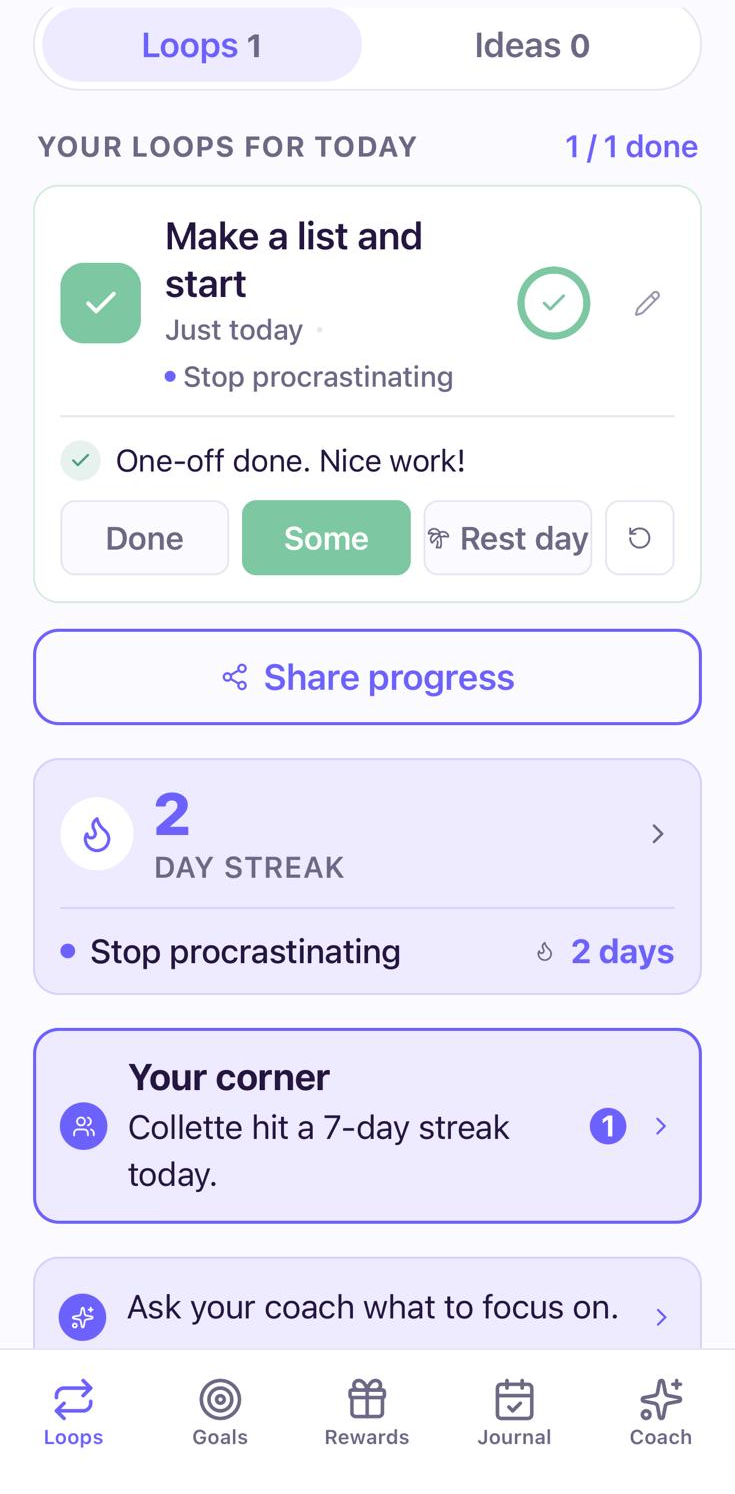
Today
Today's loops in one list. Mark it done, some, or a rest day, and see what your corner is up to.
How Loops helps
A daily system that plans for the bad days, not around them.
Most routine advice assumes the problem is finding the right system. Loops assumes the problem is what happens to any system the first time life goes sideways.
Loops gives you small daily actions, a way back in after a miss, and coaching through the moments when the routine usually breaks for good. It's not built for perfect weeks. It's built to survive the imperfect ones.
Then it adds the part most apps leave out. One person who sees you doing it. More on that just below.
Does any of this sound familiar?
You're not alone in this.
These are the patterns people with ADHD describe most often when it comes to building routines.
Missing one day feels like missing a week. The longer you leave it, the harder restarting becomes.
You've tried habit trackers, planners, apps, spreadsheets. They work for about two weeks. Then maintaining the system becomes the thing you're avoiding.
The routine felt natural when you built it. After a break, it feels like starting from scratch, even though nothing actually changed.
You know exactly what you need to do. On a bad day, you can't make yourself do any of it. Even the easy parts.
You've built and abandoned so many routines that you're starting to wonder if you're just someone who can't do this.
You can do this. The routines haven't failed because of you. They've failed because they weren't designed to survive the kind of days ADHD creates.
Understanding the pattern
It's not about willpower. It's about how ADHD changes what a bad day costs.
Routines fail for ADHD brains through a specific set of compounding mechanisms. Each one makes the next harder. Understanding them matters because each requires a different solution.
- 01
The all-or-nothing collapse
One missed day becomes proof that the whole routine is over. ADHD's poor temporal tracking makes it hard to contextualise a single miss. It doesn't feel like one skipped day. It feels like failure.
- 02
The back-to-zero spiral
Shame after a miss makes the next attempt harder, not easier. The emotional weight of a broken routine builds with every day it stays broken, until restarting feels more daunting than the routine ever did.
- 03
The novelty fade
The routine that felt energising in week one starts to feel punishing by week three. ADHD brains crave novelty and immediate reward. Once the dopamine boost of a new habit fades, the repetition itself becomes a source of low-grade aversion.
- 04
The rigid tool trap
The system you built to help you gets abandoned the first time you can't maintain it. Planners, habit trackers, and apps add a layer of complexity that requires its own consistency. When the routine breaks, so does the tool, and now there are two things to restart.
- 05
The bad day amplifier
On a low-energy day, even the simplest parts of a routine feel impossible. ADHD involves real fluctuations in arousal, working memory, and frustration tolerance. A bad day doesn't just make things harder. It changes what the brain can do.
Loops is designed around all five of these failure points, so a bad day doesn't have to become the end of the routine.
A different way to think about routines
A routine that only works on good days isn't a routine. It's a plan.
Most routine advice is written for brains where motivation is stable and disruption is the exception. For ADHD brains, it's the other way around. Disruption is expected. Variability is the baseline.
This means a routine built for perfect conditions will always eventually break. A routine built for ADHD needs a different setting built into it from the start: one small action for the bad days, with no pressure to do more. Not a fallback. Not a compromise. The actual design.
The part most apps miss
Brains finish for people, not for apps.
A routine you keep to yourself is a routine only you will miss. When one bad day breaks it, there's nobody to notice, and nobody to come back for, so it's quietly easier to let the whole thing go.
So Loops adds the one thing that reliably keeps ADHD brains going. Another person.
You choose one person you trust. Your partner, a friend, whoever feels safe. When you close a loop, they see it. When you come back after a missed day, they see that too, and it's genuinely no big deal. You decide exactly what they can see, and you can change it any time.
This is the step most people skip with other apps. It's also the one that makes Loops work.
All they have to do is see it
When you close a loop, they see it. When you come back after a missed day, they see that too, and it's genuinely no big deal. They just get to see you keep showing up, and cheer you on.
They don't watch your streak
They're not there to point out the day you missed. They don't nag, they don't manage you, they don't even pay. Their side is light on purpose.
You're always in control
You choose who it is. You decide exactly what they can see, and you can change it any time.
Coming back gets easier
When coming back feels harder than it should, one person who's glad you did makes it easier.
You can start on your own if you'd rather. It still works. It just works better when someone can see you.
Getting started
One thing, every day. Even on the hard ones.
You don't need to rebuild your routine from scratch. You need something that survives the days when you can't.
- 1Step 1
Tell Loops what you're working on
Name your routine goal in plain language. Morning structure, evening wind-down, exercise, anything you keep losing after a bad week. No categories, no setup that takes twenty minutes.
- 2Step 2
Choose your person, if you want one
Pick one person you trust to see your progress. You decide exactly what they can see, and you can change it any time. It's not another thing to manage: they simply see what you already do. This is the step most people skip with other apps, and the one that makes Loops work. It's entirely optional.
- 3Step 3
Get small daily actions
Each day, Loops gives you specific, low-friction things to do. On harder days, it's smaller. The goal is always to give your brain something it can actually do today, not the ideal version of today. Close the loop, and your person sees it.
- 4Step 4
Get coached back in after a miss
Missed a day? Loops gives you a clear, calm step back in. Not a reset. Not a reminder of the streak you broke. Just the next smallest thing.
- 5Step 5
Build something that survives
Over time, a routine that keeps restarting becomes a routine that's still running. That's the goal.
You don't need a good week to start. One action on a bad day is enough.
What's inside Loops
Five simple things, working together.
01
One goal, in your own words
Your routine goal, described your way: a morning structure, an evening wind-down, exercise, whatever you keep losing after a bad week. No categories. Just a clear picture of what you're building, so it's easy to come back to.
02
Loops that fit your life
A loop is one small, repeating action, at a pace you choose. On harder days it gets smaller, never a rule to break. Some run every day, some a few times a week: make the bed, ten minutes of tidying, lights out around the same time. A few connect to your routine. Others are just life, like taking your meds before breakfast. Miss one and nothing is wiped out. The next action is still there, still small, and designed to be the easiest way back in.
03
Your person
The one you choose to see your progress: the loops you close and the times you come back after a miss. It's not another thing to manage, they simply see what you already do.
04
Rewards you can feel
Promise yourself something for the moments that matter: the first time you came back the very next day, a month where the routine survived a bad week, six months of it still running. Loops holds the promise and calls it in when you've earned it, and your person gets to see it too.
05
A coach who knows your whole story
An AI coach built for ADHD. It already knows what you're building and where your routines tend to break, so there's no re-explaining yourself from the start. No booking, no waiting room. It's there the morning after a missed day, with the smallest possible way back in, not a reminder of the streak you broke.
What people say
From people who recognise themselves in this.
I'd built and abandoned probably twelve routines in two years. The problem was always the same: one bad day and I couldn't get back in. Loops was the first thing that gave me something to come back to that didn't feel like starting over.
Secondary school teacher
Diagnosed with ADHD at 35
The habit tracker was making it worse. Every time I looked at the broken streak I felt worse, not more motivated. Loops doesn't do that. It just asks what I can do today.
Freelance developer
Using Loops for 9 weeks
I've had my morning routine for four months now. It's not perfect. I've missed plenty of days. It's still there when I come back.
Marketing manager, Leeds
Pricing
Choose your plan
One small subscription for the coach, the loops and the streaks. Or buy credits when you need them and nothing else.
- 100 coach messages every month. Free gets 30.
- Nothing rolls over, nothing is wasted. It just resets.
- Cancel anytime.
Loops Solo
Monthly$6.99/ month
1 week free, then $6.99 a month.
Your coach, your loops and your streaks. Month to month, cancel whenever.
Loops Solo
Annual$42.99/ year
Works out at $3.58 a month.
Your coach and your streaks, for a year. Roughly half the monthly price.
Or top up
One-off packs. These credits never expire.
100
credits
100 coach message credits
$3.99
300
credits
300 coach message credits
$9.99
1,000
credits
1,000 coach message credits
Best rate
$29.99
Every plan starts with a week free. On iPhone and Android.
A few things worth knowing
Common questions before you start
“I've tried building routines before. They always break.”
That's exactly the pattern Loops is built for. The routines you've tried weren't wrong. They just weren't designed to survive the kind of days ADHD creates. Loops is.
“Do I have to share my progress with anyone?”
No. Solo works perfectly well on its own. But most people find it works better when one person can see them, and because it's just a view of what you already do, it never becomes another thing to manage. You decide what your person sees, and you can add them whenever you're ready.
“I just need more discipline.”
Discipline isn't the gap. Design is. Research on ADHD consistently shows that when routines fail, it's rarely because of commitment. It's because the system demands stable motivation that ADHD doesn't reliably supply.
“What if I'm not diagnosed?”
You don't need a diagnosis. Many people using Loops are on waiting lists, self-identifying, or simply recognise that the patterns here feel familiar. If that's you, Loops is built for you.
“Won't I just abandon Loops the way I've abandoned everything else?”
Loops is designed for exactly that risk. One daily action. No streak to protect. No elaborate system to maintain. If you miss a week, the next action is still there, still small, and designed to be the easiest possible step back in.
FAQ
Questions people often ask
Still wondering if Loops fits how your brain works? Contact us. A real person will reply.
What is Loops?
Loops is a daily coaching app for people with ADHD and anyone building better habits. It combines personalised coaching, daily micro-actions, one person who sees your progress, and accountability in one system. For routines specifically, it helps with consistency, recovery after missed days, and building something that doesn't collapse the first time life goes sideways.
Who is 'your person', and do I need one?
Your person is the one you choose to see your progress: the loops you close and the times you come back after a miss. It's not another thing to manage, they simply see what you already do. They don't watch your streak or point out the day you missed. You don't have to add one to start, but it's the part that makes Loops work, so we'll gently encourage it when you're ready.
How does Loops help with building routines if you have ADHD?
It gives you one low-friction action each day, adapted to what you can actually manage today. It also gives you a calm, practical way back in after a miss, so a bad day doesn't have to become a bad week.
Why do routines keep failing with ADHD?
The mechanisms are specific. ADHD involves real fluctuations in arousal, motivation, and frustration tolerance. One missed day triggers shame, which makes restarting harder. The novelty of a new routine fades and the repetition starts to feel punishing. And the tools built to help often require their own maintenance. None of this is about commitment.
Do I need an ADHD diagnosis to use Loops?
No. Loops is designed first for people with ADHD but doesn't require a formal diagnosis. If the experiences described here feel familiar, Loops is built for you.
What's the difference between Loops and a habit tracker?
Habit trackers record what you do or don't do. Loops coaches you through the moments when you're not doing it. A tracker shows you a broken streak. Loops gives you the next step after one.
What if I have a terrible month and fall off everything?
That's built into the design. Loops doesn't treat a terrible month as a reason to start over from scratch. The next daily action is still there, calibrated to be the smallest useful step back in.
Is Loops available in the UK?
Yes. Loops is available across the UK and is designed around UK contexts and guidance.
How long before a routine actually sticks?
There's no fixed answer, because sticking isn't a single moment. It's a pattern of restarting. Most people notice the restarts getting easier within the first few weeks. The routine becoming genuinely durable usually takes longer, and Loops is designed to make that achievable rather than aspirational.
Still running, six months on
Six months from now, still running.
Not perfectly. Not without bad days. Still there when you come back, and, if you want, one person there when you do.
Get Your Account, Free Forever Today.
*Terms and Conditions Apply.
*Terms and Conditions Apply.
New to Loops? It's a free habit tracker built around small daily steps, and almost everything in it costs nothing.
Our sources
Where this comes from
This page draws on ADHD clinical guidelines, research into executive function, time perception and emotional regulation, and real accounts from people who've built a routine before and watched it collapse. Here's where it comes from.
- Attention deficit hyperactivity disorder: diagnosis and management — NICE
- Recommendations | ADHD diagnosis and management — NICE
- Non-pharmacological interventions — Australian ADHD Clinical Practice Guideline
- The Important Role of Executive Functioning and Self-Regulation — Russell Barkley
- Time Perception is a Focal Symptom of Attention-Deficit Hyperactivity Disorder — PMC
- Emotional Dysregulation and Attention-Deficit/Hyperactivity Disorder — PMC
- ADHD as a Circadian Rhythm Disorder: Evidence and Debate — PMC
- Delay Aversion and Executive Functioning in Adults With ADHD — PMC
- The Lived Experiences of Adults With Attention-Deficit Hyperactivity Disorder — PubMed
- My Life Is Falling Apart. Please Give Me Apps That Actually Help — r/adhdwomen
- Anybody Here Using Tiimo (Visual Planner App)? — r/adhdwomen
- Do You Like Routine But Also Hate It? — r/ADHD
- An Investigation of Body Doubling With Neurodivergent Users — ACM
- Benefits and Harms of ADHD Interventions: An Umbrella Review — BMJ
- A Meta-Analysis of the Intervention Effect of Cognitive-Behavioural Therapy — PubMed
- ADHD Coaching — Australian ADHD Clinical Practice Guideline
- Don't Buy That Planner, You Know You Won't Use It — r/ADHD
- Complex Prospective Memory in Adults With Attention Deficit Hyperactivity Disorder — PLOS ONE
- The Relationship Between Organization in Time, Executive Function and Quality of Life — PubMed
- Experiences of Criticism in Adults With ADHD: A Qualitative Study — PubMed
- Coaching for Adults With ADHD: A Prospective Study — PubMed
Loops is a daily coaching app, not a medical or clinical service. These sources inform how we think about ADHD and routines; they are not an endorsement of Loops by their authors.