
You've avoided opening your banking app for longer than you'd like to admit.
Designed for ADHD. Works for everyone.
Avoiding your banking app doesn't mean you don't care about money.
Bills, admin, and saving all ask for steady, future-focused follow-through. ADHD makes exactly that harder, which is why avoidance often feels easier than looking.
Loops is a daily coaching app for people with ADHD. It gives you small daily actions, gentle check-ins instead of one overwhelming review, and, if you want it, one person in your corner who won't judge.
Get Your Account, Free Forever Today.
*Terms and Conditions Apply.
*Terms and Conditions Apply.
Three things Loops does for you
Make looking feel safer
Small, judgement-free check-ins instead of one big dreaded review.
Keep bills money separate
Support so bill money stops quietly becoming spending money.
Catch admin before it snowballs
Gentle nudges for renewals, letters, and tasks that turn into crises if left.
Loops is a daily coaching app for people with ADHD.
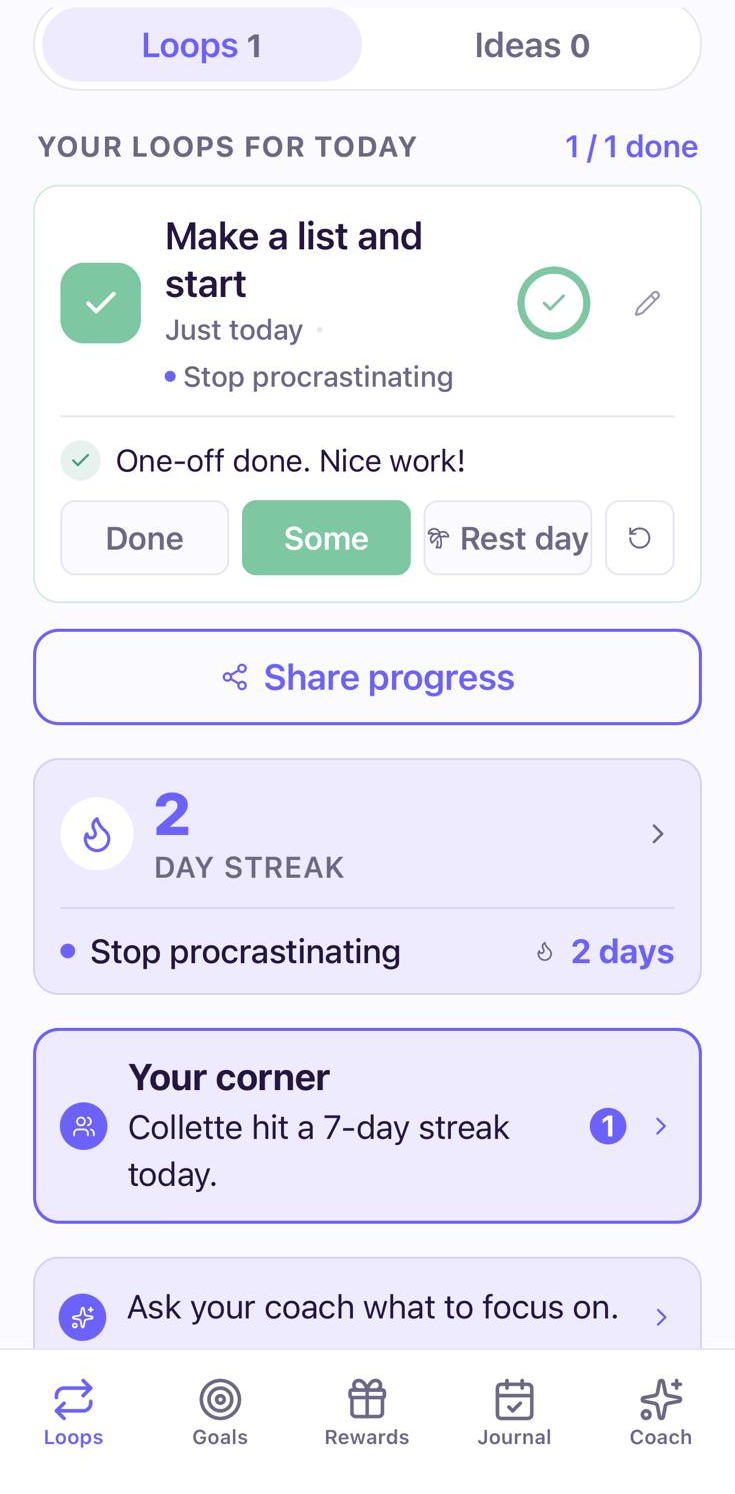
Today
Today's loops in one list. Mark it done, some, or a rest day, and see what your corner is up to.
How Loops helps
A daily system built for the part that actually breaks.
You don't need another spreadsheet or a lecture about budgeting basics. You need looking at your money to feel less threatening, and the boring admin to stop sneaking up on you.
Loops gives you small daily actions, gentle check-ins instead of one overwhelming review, and support catching admin before it becomes urgent.
Then it adds the part most apps leave out. One person quietly in your corner. More on that just below.
Does any of this sound familiar?
You're not alone in this.
These are the patterns people with ADHD describe most often around money. If you see yourself here, you're in the right place.
Bills money has a habit of quietly becoming spending money before the bill is due.
A small purchase has given you a quick lift on a hard or boring day, more than once.
A letter or renewal sat unopened until it turned into a much bigger problem.
You've started a budget, spreadsheet, or savings plan that worked brilliantly for about two weeks.
You've felt too ashamed about a money mistake to tell anyone, even people who'd understand.
None of this means you're bad with money. It means money habits ask for exactly the kind of steady, future-focused follow-through ADHD makes harder.
Understanding the pattern
It's not a money knowledge problem. It's a follow-through problem.
Financial security depends on remembering, separating, delaying, and following through over time. Knowing the "right" thing to do has rarely been the missing piece.
- 01
The visibility gap
Avoiding a look at your finances can feel safer than facing them. That avoidance usually turns a manageable problem into a bigger one, through late fees or missed payments.
- 02
The leak gap
Money for bills sitting in the same place as everyday spending money feels mentally available. By the time the bill is due, it's often already gone.
- 03
The relief-spending gap
A small purchase can offer fast relief from boredom, stress, or a flat mood. That's not weak willpower. It's a quick, accessible way to feel better in the moment.
- 04
The admin gap
Renewals, letters, and forms often get delayed until the consequences are serious. What's sometimes called the “ADHD tax” is largely the cost of this exact pattern.
- 05
The shame gap
Repeated money mistakes tend to get filed away as proof of being irresponsible. That belief makes it harder to ask for help, which makes the next mistake more likely.
None of these gaps mean you don't care about your finances. They mean the systems around money need to work with how your brain runs, not against it.
Something worth knowing
Why budgeting apps work for two weeks and then stop.
A new spreadsheet, app, or "fresh start" budget often works brilliantly at first. Then the novelty fades, and the daily upkeep it asks for, logging, reviewing, deciding, becomes its own boring task that gets skipped, just like everything else that depends on steady repetition.
That's not a sign the plan was wrong. It's a sign the plan asked for the wrong kind of effort. The fix isn't a better spreadsheet. It's a system that needs less from you to keep working.
The part most apps miss
Brains follow through for people, not for apps.
Money is the thing people hide hardest. The page names it: a mistake can feel too shaming to tell anyone, even people who'd understand. Carried alone and unseen, that shame is exactly what keeps the banking app closed.
So Loops adds the one thing that reliably keeps ADHD brains going. Another person.
You choose one person you trust, someone whose being there feels safe. When you close a loop, they see it. Not your balance, not your spending, not the mistakes, just the small steps you're taking. You decide exactly what they can see, and you can change it any time.
This is the step most people skip with other apps. It's also the one that makes Loops work.
They see the steps, not the numbers
When you close a loop, they see it. Not your balance, not your spending, not the mistakes, just the small steps you're taking. They get to see you keep looking, gently, instead of turning away.
They don't audit you
They don't audit you or ask about the numbers. They don't manage you, they don't even pay. Their side is light on purpose.
You're always in control
You choose who it is, someone whose being there feels safe. You decide exactly what they can see, and you can change it any time.
Takes the shame's power away
When the shame is what's keeping you from your own finances, one person who isn't judging you takes some of its power away.
And if you'd rather keep this completely private, that's more than fine, and probably what most people want with money. Solo works on its own. Your person is there for if and when you want it.
Getting started
Simple from day one.
You don't need to overhaul your whole financial life. Loops fits around the money habits you're already trying to build.
- 1Step 1
Tell Loops what feels hardest
Name the part of money that keeps slipping, whether that's looking, saving, or admin.
- 2Step 2
Choose your person, if you want one
Optional, and with money most people keep it private, which is completely fine. If you'd like someone alongside you, pick one person you trust to see the small steps you're taking, never your balance or your spending. You decide exactly what they can see, and you can change it any time.
- 3Step 3
Get small daily actions
Short, specific things to do each day. No full financial review required. Close the loop, and your person sees it.
- 4Step 4
Get gentle support, not judgement
Check-ins designed to feel safe, not like an audit of past mistakes.
- 5Step 5
Catch admin before it snowballs
Quiet nudges for renewals and letters, so small tasks don't turn into bigger problems.
You don't need a perfect system. You just need today's small step.
What's inside Loops
Five simple things, working together.
01
One goal, in your own words
The part of money that keeps slipping, described your way: looking, saving, admin, whatever it is. No categories, no spreadsheet. Just a clear sense of where you want things to feel less threatening.
02
Loops that fit your life
A loop is one small, repeating action, at a pace you choose, small enough to do without dread. Some run every day, some a few times a week: open the banking app for ten seconds, move the bill money aside, open one letter you've been avoiding. A few connect to your goal. Others are just life, like taking your meds before breakfast. Miss one and nothing is wiped out. The next action is still there, still small, still doable.
03
Your person
The one you choose to see the small steps you're taking, never your balance, your spending, or your mistakes. A safe pair of eyes in your corner, not an auditor.
04
Rewards you can feel
Promise yourself something for the moments that matter: a week you kept looking, the bill money that stayed put, the letter opened before it became a crisis. Loops holds the promise and calls it in when you've earned it, and your person gets to see it too.
05
A coach who knows your whole story
An AI coach built for ADHD. It already knows the part of money you find hardest, so there's no re-explaining yourself from the start. No booking, no waiting room. It's there when opening the app feels too much, or an admin task has been sitting, with a small, calm next step and no lecture.
What people say
From people who recognise themselves in this.
I hadn't opened my banking app in over a month. The shame had built up that much. Small, judgement-free check-ins got me looking again without the dread.
Freelance designer
Diagnosed with ADHD at 33
I used to spend my rent money without meaning to. Having something separate the bills money for me, gently, made the biggest difference.
In a shared flat
Using Loops for 5 months
I'd started four budgeting apps before this one. The difference was how little it asked of me to keep going.
Retail manager, Liverpool
Pricing
Choose your plan
One small subscription for the coach, the loops and the streaks. Or buy credits when you need them and nothing else.
- 100 coach messages every month. Free gets 30.
- Nothing rolls over, nothing is wasted. It just resets.
- Cancel anytime.
Loops Solo
Monthly$6.99/ month
1 week free, then $6.99 a month.
Your coach, your loops and your streaks. Month to month, cancel whenever.
Loops Solo
Annual$42.99/ year
Works out at $3.58 a month.
Your coach and your streaks, for a year. Roughly half the monthly price.
Or top up
One-off packs. These credits never expire.
100
credits
100 coach message credits
$3.99
300
credits
300 coach message credits
$9.99
1,000
credits
1,000 coach message credits
Best rate
$29.99
Every plan starts with a week free. On iPhone and Android.
A few things worth knowing
Common questions before you start
“Won't this just feel like an audit of how badly I've handled things?”
No, and that's exactly what it's designed to avoid. Loops focuses on small steps going forward, not a detailed review of past spending.
“Do I have to share any of this with anyone?”
No, and with money most people keep it private, which is completely fine. If you'd like someone alongside you, they only ever see the small steps you choose to share, never your balance, your spending, or your mistakes. You decide what your person sees, and you can add them whenever you're ready.
“I've tried budgeting apps before. They didn't last.”
Most budgeting apps ask for steady manual upkeep. Loops is built around small, low-effort daily actions instead, since that's usually where manual systems break down first.
“I'm worried looking at my finances will make me feel worse.”
That fear is common, and it's exactly why the check-ins are designed to be gentle. Looking a little at a time tends to feel far less overwhelming than one big dreaded review.
“What if I'm already in serious debt or financial trouble?”
Loops can support daily habits, but it isn't a substitute for debt advice, and it isn't financial advice. If things have become serious, free and confidential debt advice is available in the UK, from services like Citizens Advice, StepChange, or National Debtline, and reaching out to one of them is genuinely worth it. Loops can sit alongside that support, not in place of it.
FAQ
Questions people often ask
Still wondering if Loops fits how your brain works? Contact us. A real person will reply.
What is Loops?
Loops is a daily coaching app for people with ADHD and anyone building better habits. For money, it focuses on small daily actions, one person who can be a safe, non-judging ally, gentle check-ins instead of overwhelming reviews, and help catching admin before it becomes a crisis.
Who is 'your person', and do I need one?
Your person is the one you choose to see the small steps you're taking, never your balance, your spending, or your mistakes. They don't audit you or ask about the numbers. When shame is what's keeping you from your own finances, one person who isn't judging you takes some of its power away. You don't need one to start, and with money most people keep it private, which is completely fine. Your person is there for if and when you want it.
How does Loops help with money if you have ADHD?
It breaks financial habits into one manageable daily step, makes looking at money feel less threatening, and helps catch renewals and admin before they snowball into bigger problems.
Why is financial security harder with ADHD even when I understand money basics?
Financial habits depend on remembering, separating funds mentally, delaying gratification, and following through consistently, all areas ADHD affects, separately from financial knowledge.
Do I need an ADHD diagnosis to use Loops?
No. Loops is designed first for people with ADHD but doesn't require a formal diagnosis. If the patterns on this page feel familiar, Loops is built for you.
Is this a substitute for financial or debt advice?
No. Loops supports daily money habits and isn't a financial adviser or debt counsellor. If you're dealing with serious debt, free confidential debt advice is available. You can find services on Find help now.
Will this fix my finances completely?
No, and it wouldn't be honest to promise that. Loops is built to help with the daily habits that tend to break down, like looking, separating funds, and catching admin, not to replace budgeting fundamentals or professional advice.
How long does it take to see results?
Some people notice a difference in how looking at their finances feels within the first couple of weeks. Steadier habits, like an emergency buffer staying intact, usually build over a few months.
Is Loops available in the UK?
Yes. Loops is available across the UK.
Open the app today
Open the app today. Not a perfect financial plan.
You don't need to overhaul how you handle money. You need today's small step toward looking at it a little more easily, and, if you want, one person quietly in your corner.
Get Your Account, Free Forever Today.
*Terms and Conditions Apply.
*Terms and Conditions Apply.
New to Loops? It's a free ADHD app built around small daily steps, and almost everything in it costs nothing.
Our sources
Where this comes from
This page draws on ADHD research into financial decision-making and delay discounting, clinical guidance, and real accounts of avoiding bank apps and letting admin pile up. Here's where it comes from.
- Attention Deficit Hyperactivity Disorder: Diagnosis and Management — NICE
- The Important Role of Executive Functioning and Self-Regulation in ADHD — Russell Barkley
- The Long-Term Financial Outcome of Children Diagnosed With ADHD — Nova Southeastern University
- Attention-Deficit/Hyperactivity Disorder and Monetary Delay Discounting: A Meta-Analysis of Case-Control Studies — PMC
- Financial Judgment Determination in Adults With ADHD — PubMed
- ADHD Management Information, May 2025 — NHS England Digital
- The Lived Experiences of Adults With ADHD: A Rapid Review of Qualitative Evidence — Frontiers in Psychiatry
- ADHD and Money: What's Your Biggest Struggle? — r/ADHD
- Impulsive Buying and Deferment of Gratification Among Adults With ADHD — Clinical Psychology in Europe
- How to Stop Accidentally Spending My Rent and Bills Money — r/ADHD
- The ADHD Tax: What's the Most You've Ever Paid? — r/ADHD
- Budgeting for Neurodivergent Adults — MoneyHelper
- Adult ADHD Patient Experiences of Impairment, Service Provision and Clinical Management in England: A Qualitative Study — BMC Health Services Research
- A Systematic Review of Interventions to Support Adults With ADHD at Work — Frontiers in Psychology
- Tell Me Your ADHD Tax Stories — r/ADHD
- Occupational Issues of Adults With ADHD — PMC
- Plain English Summary of the ADHD Taskforce Report — NHS England
- The Application of Behavioural Insights to Financial Literacy and Investor Education Programmes and Initiatives — OECD
- Benefits and Harms of ADHD Interventions: Umbrella Review and Platform for Shared Decision Making — University of Oxford
Loops is a daily coaching app, not a medical, clinical, or financial advice service. These sources inform how we think about ADHD and money; they are not an endorsement of Loops by their authors.