
You start strong, then a few days later you can't quite remember where you left off.
Designed for ADHD. Works for everyone.
You always start. The hard part is everything after that.
Starting isn't really your problem. It's the middle, the gap after an interruption, and the final stretch that quietly undo things, again and again.
Loops is a daily coaching app for people with ADHD. It gives you small daily actions, an easy way back in after a gap, a clear sense of what done looks like, and, if you want it, one person waiting to see it finished.
Get Your Account, Free Forever Today.
*Terms and Conditions Apply.
*Terms and Conditions Apply.
Three things Loops does for you
Pick the thread back up
A clear way back in after life pulls you away mid-task.
Get a real read on time
Support for the part of your brain that keeps misjudging how long things take.
Cross the actual finish line
Help defining what “done” means, so things stop hovering at ninety percent.
Loops is a daily coaching app for people with ADHD.
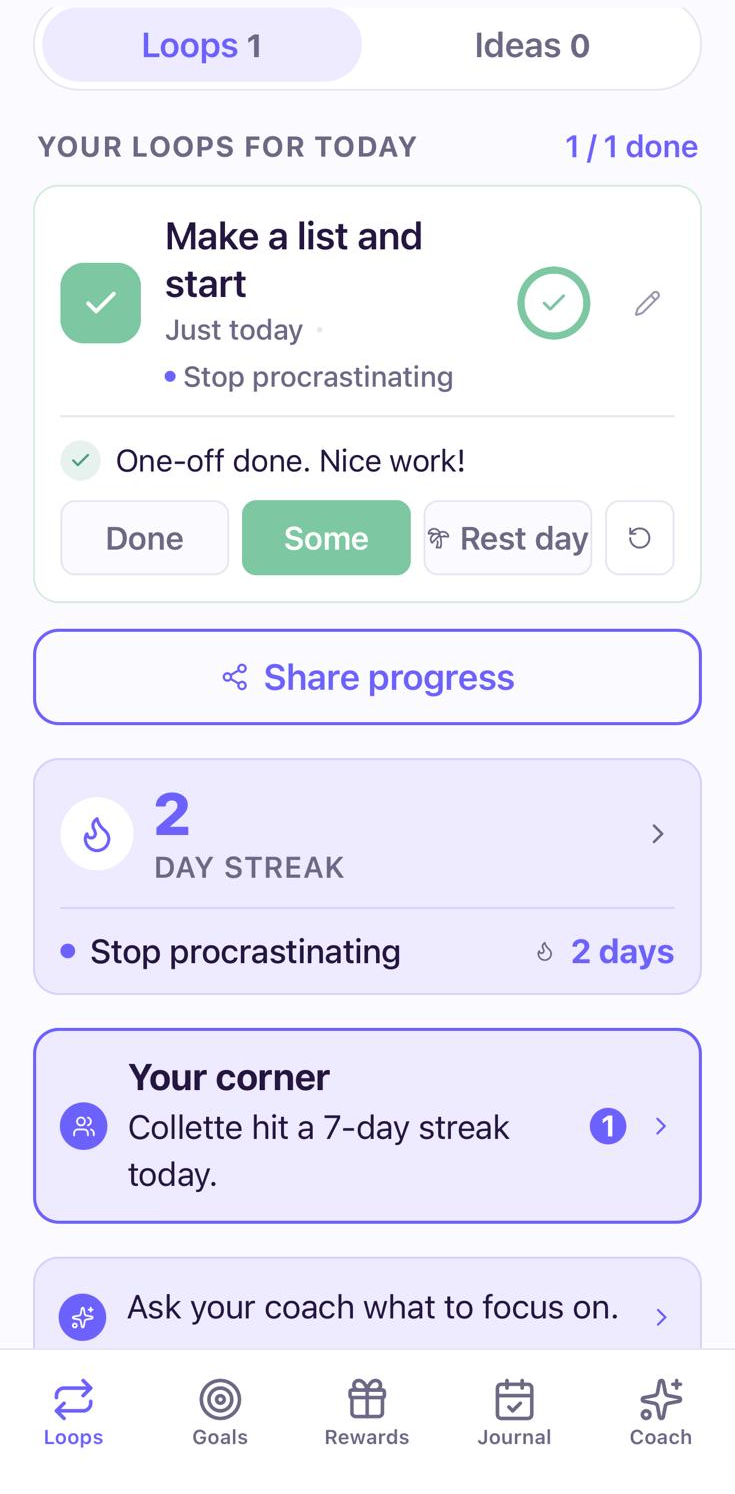
Today
Today's loops in one list. Mark it done, some, or a rest day, and see what your corner is up to.
How Loops helps
A daily system built for the part after the start.
Most advice focuses on getting going. Loops focuses on what happens next: staying with a task once the novelty fades, finding your way back after an interruption, and recognising when something is actually finished.
It gives you small daily actions, a way to pick things back up without starting over, and a clearer sense of what done actually looks like.
Then it adds the part most apps leave out. One person who sees you doing it. More on that just below.
Does any of this sound familiar?
You're not alone in this.
These are the patterns people with ADHD describe most often when things don't get finished. If you see yourself here, you're in the right place.
Something is ninety percent done and has been for weeks. The last ten percent never happens.
You genuinely thought you had more time than you did, again.
A task gets interrupted and somehow never reopens.
You finish in a last-minute sprint and feel both relieved and ashamed about how it happened.
Every unfinished thing feels like more proof you can't be trusted to follow through.
None of this means you don't care enough. It means the part after starting needs its own kind of support.
Understanding the pattern
It's not a willpower problem. It's a chain with several weak links.
Finishing something asks for more than starting it. It asks you to keep going once it's no longer new, find your way back after a break, and recognise the moment it's actually over.
- 01
The starting gap
A vague task is much harder to begin than a specific one. Until a task has a clear, small first move, it's reasonable for it to sit untouched.
- 02
The time gap
Estimating how long something will take is genuinely harder for ADHD brains. That's why deadlines arrive feeling sudden, even when they were marked weeks in advance.
- 03
The resumption gap
Picking a task back up after an interruption is its own separate skill. Losing the thread isn't carelessness. It's a known weak point in how ADHD affects working memory.
- 04
The shame gap
Unfinished tasks tend to get filed away as proof of a personal flaw. That belief makes the next attempt feel riskier, which makes starting again even harder.
- 05
The finish line gap
“Done” is often less obvious than it sounds. Without a clear definition, tasks can hover at nearly finished indefinitely.
None of these gaps mean something is wrong with you. They mean the chain needs support at more than one point.
Something worth knowing
Starting and finishing are not the same skill.
Most advice assumes that once you've started, the rest takes care of itself. For a lot of people with ADHD, that's exactly backwards. The hardest moments are often in the middle, after the first burst of focus fades, or right at the end, when a task is nearly done but doesn't feel finished yet.
That's why tips about getting started can work brilliantly and still leave the actual problem untouched. Finishing needs its own support, built for the messy middle and the final stretch, not just the first five minutes.
The part most apps miss
Brains finish for people, not for apps.
Look at the last gap on that list: things hover at ninety percent because nobody is waiting for the finished version. A task only you are tracking has nothing outside your own fading interest holding it to the end.
So Loops adds the one thing that reliably keeps ADHD brains going. Another person.
You choose one person you trust. Your partner, a friend, whoever it is. When you close a loop, they see it. When the thing is finally done, they see that too. When you pick it back up after a gap, that's seen as well, and it's no big deal. You decide exactly what they can see, and you can change it any time.
This is the step most people skip with other apps. It's also the one that makes Loops work.
The someone-waiting a task lacks
A task only you are tracking has nothing outside your own fading interest holding it to the end. When you close a loop, they see it. When the thing is finally done, they see that too.
They don't chase you
They don't have to nag you or chase you. They don't manage you, they don't even pay. Their side is light on purpose.
You're always in control
You choose who it is. You decide exactly what they can see, and you can change it any time.
The finish isn't only yours
Suddenly the finish isn't only yours to hold, and someone waiting is often the difference between ninety percent and finished.
You can start on your own if you'd rather. It still works. It just works better when someone can see you.
Getting started
Simple from day one.
You don't need a new system for every task. Loops fits around what you're already trying to finish.
- 1Step 1
Tell Loops what you're trying to finish
Name the task in plain language, however unfinished or messy it currently is.
- 2Step 2
Choose your person
Pick one person you trust to see your progress, so the finish has someone waiting, not just you tracking it. You decide what they can see, and you can change it any time. This is the step most people skip with other apps, and the one that makes Loops work.
- 3Step 3
Get one small daily action
A short, specific next step each day. No need to plan the whole thing in advance. Close the loop, and your person sees it.
- 4Step 4
Pick it back up easily after a gap
A missed day or a derailed week doesn't mean starting from scratch. Loops helps you find your way back in.
- 5Step 5
Know when it's actually done
Loops helps you define what finished looks like before you start, so the last stretch doesn't drag on forever.
You don't need a perfect run. You just need today's step.
What's inside Loops
Five simple things, working together.
01
One goal, with a finish line
The task you're trying to finish, in your own words, however messy it is right now, along with what “done” actually means for it. Defining the finish line up front is what stops things hovering at ninety percent.
02
Loops that fit your life
A loop is one small, repeating action, at a pace you choose, giving you a clear next step so you never have to plan the whole thing in advance. Some run every day, some a few times a week: the next specific step, fifteen minutes on the last ten percent, reopening the thing you got interrupted on. A few connect to what you're finishing. Others are just life, like taking your meds before breakfast. Miss one and nothing is wiped out. The next action is still there, still small, still doable.
03
Your person
The one you choose to see your progress: the loops you close, the moment it's done, and the times you pick it back up after a gap. The someone-waiting an unfinished task usually lacks.
04
Rewards you can feel
Promise yourself something for the moments that matter: the interrupted thing reopened, the last ten percent finally done, a finish that wasn't a last-minute sprint. Loops holds the promise and calls it in when you've earned it, and your person gets to see it too.
05
A coach who knows your whole story
An AI coach built for ADHD. It already knows what you're finishing and where the chain tends to break, so there's no re-explaining yourself from the start. No booking, no waiting room. It's there when you've lost the thread or the last stretch has stalled, with the next small step, not a reminder of how long it's been sitting.
What people say
From people who recognise themselves in this.
I had three things at ninety percent for over a year. Having a clear sense of what 'done' meant for each one was what finally moved them.
Graphic designer
Diagnosed with ADHD at 31
I used to lose a project completely if I got interrupted halfway through. Now I have a way back in, instead of starting over every time.
University student
Using Loops for 4 months
I always knew what to do. I just couldn't seem to keep going once the new feeling wore off. This helped with the middle, not just the start.
Operations manager, Leeds
Pricing
Choose your plan
One small subscription for the coach, the loops and the streaks. Or buy credits when you need them and nothing else.
- 100 coach messages every month. Free gets 30.
- Nothing rolls over, nothing is wasted. It just resets.
- Cancel anytime.
Loops Solo
Monthly$6.99/ month
1 week free, then $6.99 a month.
Your coach, your loops and your streaks. Month to month, cancel whenever.
Loops Solo
Annual$42.99/ year
Works out at $3.58 a month.
Your coach and your streaks, for a year. Roughly half the monthly price.
Or top up
One-off packs. These credits never expire.
100
credits
100 coach message credits
$3.99
300
credits
300 coach message credits
$9.99
1,000
credits
1,000 coach message credits
Best rate
$29.99
Every plan starts with a week free. On iPhone and Android.
A few things worth knowing
Common questions before you start
“I already know what I need to do. Knowing isn't the problem.”
You're right, and that's exactly what this is built around. Loops doesn't focus on teaching you what to do. It focuses on the gap between knowing and actually following through.
“Do I have to share my progress with anyone?”
No. Solo works perfectly well on its own. But most people find it works better when one person can see them, because a finish with someone waiting is far more likely to happen. You decide what your person sees, and you can add them whenever you're ready.
“I've tried tips for starting tasks before. They didn't help.”
Most advice stops at the first five minutes. Loops is built around the middle and the end too, where a lot of ADHD finishing problems actually happen.
“What if I get derailed again halfway through?”
That's expected, not a failure. Loops is designed to help you pick a task back up easily, rather than assuming you'll never get interrupted.
“I don't have time to learn another system.”
There's no system to learn. Setup takes a few minutes, and each day asks for one small, specific action.
FAQ
Questions people often ask
Still wondering if Loops fits how your brain works? Contact us. A real person will reply.
What is Loops?
Loops is a daily coaching app for people with ADHD and anyone building better habits. For finishing things, it focuses on one small daily action, one person who sees your progress, easy resumption after interruptions, and a clear sense of what done looks like.
Who is 'your person', and do I need one?
Your person is the one you choose to see your progress: the loops you close, the moment it's done, and the times you pick it back up after a gap. They don't chase you or nag you. Things hover at ninety percent because nobody is waiting, and one person waiting is often the difference between ninety percent and finished. You don't have to add one to start, but it's the part that makes Loops work, so we'll gently encourage it when you're ready.
How does Loops help with finishing things if you have ADHD?
It breaks a task into one small daily step, helps you find your way back in after a gap or interruption, and helps you define what finished actually means before you start.
Why is finishing harder than starting with ADHD?
Finishing asks for sustained attention, accurate time judgement, and the ability to resume after interruption. Each of these is affected by how ADHD impacts working memory, time perception, and motivation, separately from the act of starting.
Do I need an ADHD diagnosis to use Loops?
No. Loops is designed first for people with ADHD but doesn't require a formal diagnosis. If the patterns on this page feel familiar, Loops is built for you.
Will this stop me needing last-minute sprints altogether?
We can't promise that entirely, but Loops is built to reduce how often you rely on one, by supporting the steady middle stretch rather than only the deadline.
What if I've already tried lots of productivity apps?
That's common. Loops is built around the specific gaps that tend to break ADHD follow-through, like resumption and defining done, rather than general task management.
How long does it take to see results?
Some people notice a difference in how a task feels within the first week or two. Finishing larger or longer-running things usually takes a few consistent weeks.
Is Loops available in the UK?
Yes. Loops is available across the UK.
Finish one thing
Finish one thing. Not everything.
You don't need a complete overhaul of how you work. You need today's step on one thing that's been waiting, and, if you want, one person waiting to see it done.
Get Your Account, Free Forever Today.
*Terms and Conditions Apply.
*Terms and Conditions Apply.
New to Loops? It's a free productivity app built around small daily steps, and almost everything in it costs nothing.
Our sources
Where this comes from
This page draws on clinical guidance, research into executive function, time perception and emotion regulation, and real accounts from people with a habit of finishing things at the last possible minute. Here's where it comes from.
- Attention Deficit Hyperactivity Disorder: Diagnosis and Management — NICE
- The Lived Experiences of Adults With ADHD: A Rapid Review of Qualitative Evidence — Frontiers in Psychiatry
- Emotion Dysregulation in Adults With ADHD: A Meta-Analysis — PubMed
- Using the Temporal Motivation Theory to Explain the Relation Between ADHD and Procrastination — Australian Psychologist
- Stress and Work-Related Mental Illness Among Working Adults With ADHD: A Qualitative Study — PubMed
- The Relation Between Procrastination and Symptoms of ADHD in Undergraduate Students — PubMed
- Time Perception in Adult ADHD: Findings From a Decade — A Review — PMC
- ADHD, Executive Function and Self-Regulation — Russell Barkley
- Experiences of Criticism in Adults With ADHD: A Qualitative Study — White Rose Research Online
- Favourite Strategies for Initiating Tasks With ADHD — r/ADHD
- Cognitive-Behavioural and Skills-Based Intervention Research in ADHD — Journal of the American Academy of Child & Adolescent Psychiatry
- Effectiveness of Cognitive Behavioural-Based Interventions for Adults With ADHD Extends Beyond Core Symptoms: A Meta-Analysis of RCTs — PubMed
- A Systematic Review of Interventions to Support Adults With ADHD at Work — Frontiers in Psychology
- Evaluating the Evidence: A Systematic Review of Reviews of the Effectiveness and Safety of Digital Interventions for ADHD — PMC
- Evidence of Emotion Dysregulation as a Core Symptom of Adult ADHD: A Systematic Review — PubMed
Loops is a daily coaching app, not a medical or clinical service. These sources inform how we think about ADHD and finishing what you start; they are not an endorsement of Loops by their authors.